The Digital Employee: Deploying AI Personas With Memory, Voice, and Workflow Hooks
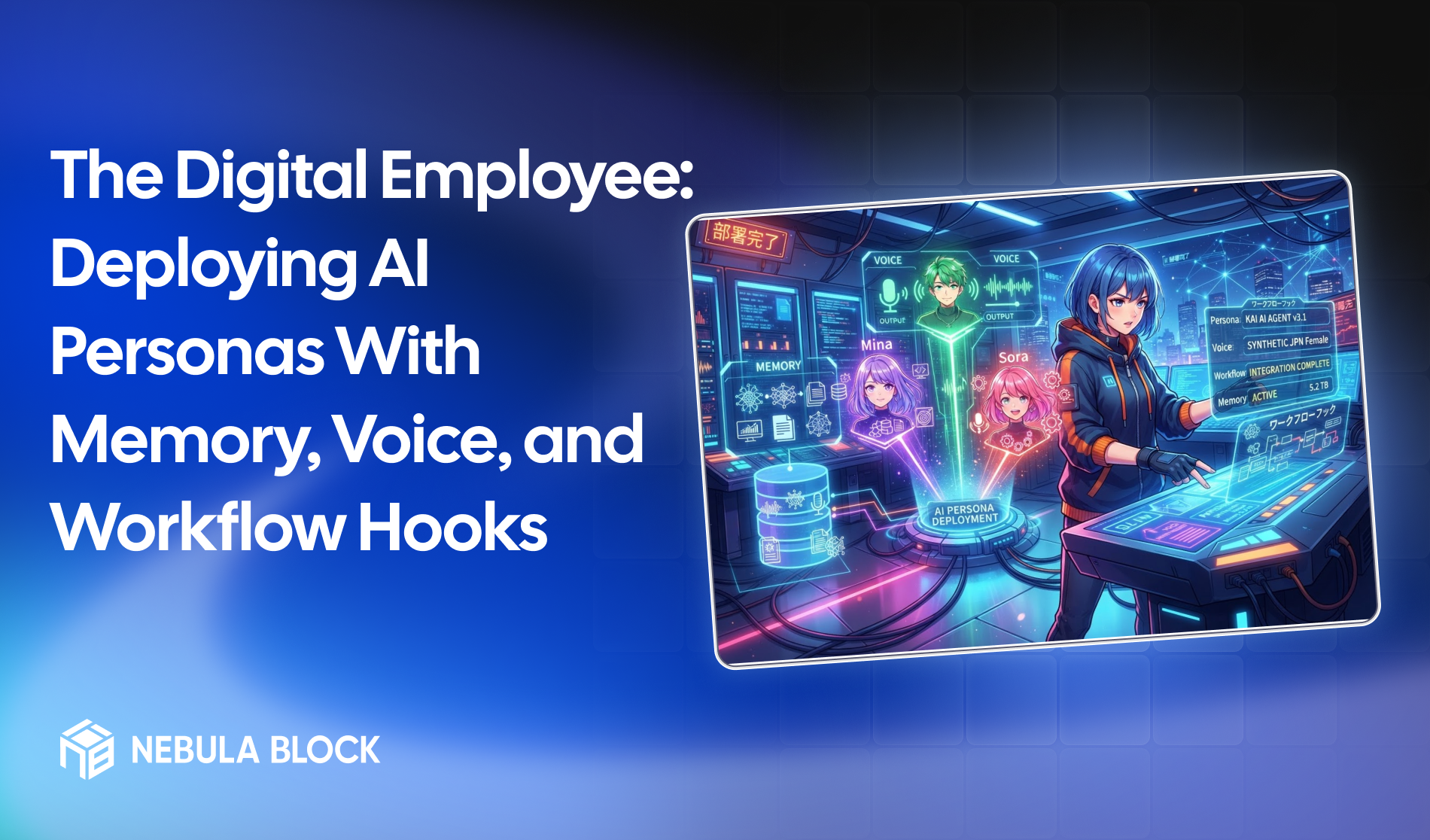
Give a chatbot a name and an avatar, and it's still a chatbot — a stateless interface that answers whatever's typed into it and forgets everything the moment the tab closes.
A "digital employee" is a different claim entirely: a persona with an ongoing role, a memory of what it's already done, more than one way to communicate, and real permission to act on the systems it's supposed to support. Most things marketed as digital employees today are the first kind wearing the branding of the second.
What Actually Makes Something a Digital Employee
Three properties separate a genuine digital employee from a themed chat interface.
- Persistent identity and memory. A real employee doesn't relearn your account history every time you contact them — they, or the systems around them, remember. A digital employee needs the same: a long-term memory layer that persists across every interaction with a given customer, project, or system, rather than resetting with each new session.
- Multi-channel presence. Human employees don't operate through a single interface — they're reached by email, chat, phone, and internal tools, and the context follows them across all of it. A digital employee built around a single chat widget is a chatbot with a job title; one built to hold the same persona and memory whether it's responding by voice, Slack, or email is closer to the real thing.
- Workflow authority. A human support rep doesn't just tell a customer what should happen next — they update the account, issue the credit, escalate the ticket. A digital employee needs equivalent hooks into the systems it's meant to operate: not a description of the action, but the authorized ability to take it, within defined limits. This is the same operator-versus-assistant distinction we've written about at length — a digital employee, by definition, has to be an operator, not an assistant with a persona painted on top.
The Architecture Behind a Digital Employee
- Persona design is the layer people notice first and matters least architecturally — a name, a tone, a defined scope of responsibility. It's important for adoption and trust, but it's a thin layer sitting on top of everything else; a well-designed persona wrapped around weak memory and no workflow authority is still just a themed chatbot.
- Memory gives the persona continuity: what this specific customer or project has already involved, what's already been tried, what's already been promised. Without this layer, a digital employee re-introduces itself every conversation, which breaks the entire premise of a role that's supposed to persist.
- Voice and channel integration lets the same underlying persona and memory surface consistently across however the business needs to reach people — a chat widget, a phone system with speech-to-text and text-to-speech, an email inbox it monitors and responds from, an internal Slack channel. The channel is a delivery mechanism; the identity and memory underneath should stay constant regardless of which one is in use at a given moment.
- Workflow hooks connect the persona to the actual systems of record — CRM, ticketing, scheduling, payment processing — scoped narrowly to the specific actions it's authorized to take. This is usually the most underinvested layer in early digital-employee deployments, because it requires real integration engineering rather than prompt engineering, and it's tempting to skip it and let the persona simply describe what a human should do instead.
- Escalation and oversight define what happens at the edge of the persona's authority — the cases it recognizes as outside its scope, hands to a human, and (ideally) learns from over time. A digital employee without a well-defined escalation path either overreaches into decisions it shouldn't make alone, or under-reaches by escalating everything and providing no real automation value. Getting this boundary right is as much a governance decision as a technical one.
Where This Pattern Actually Earns Its Complexity
Not every role is a good candidate for a digital employee, and treating this as a default rather than a deliberate choice leads to over-engineered deployments for tasks that never needed persistent identity in the first place.
The pattern earns its complexity specifically for roles defined by recurring relationships and repeated action over time: an account manager persona that maintains context across a long customer relationship, an onboarding persona that walks new hires through weeks of process while remembering what's already been completed, a triage persona that handles the same category of request repeatedly and needs to act, not just advise, within a defined scope.
A single-purpose FAQ bot doesn't need a name, a memory layer, or workflow authority — it needs to answer questions well, and building operator-grade infrastructure around it is wasted effort. The judgment call is recognizing which roles in your organization are actually structured like an ongoing relationship with repeated action, versus which just need a better answer engine.
Governance Is Not Optional
A digital employee that can act on real systems needs the same kind of oversight a new human hire would get, formalized as system architecture rather than management practice: clear boundaries on what it's authorized to do, an audit trail of every action it takes and why, and a defined path for a human to review, override, or retrain it. Skipping this because "it's just automation" is how a well-intentioned deployment turns into an incident — the persona branding makes the system feel more trustworthy than the underlying authorization and audit infrastructure actually justifies, which is exactly the gap that needs closing before deployment, not after.
Conclusion
A digital employee is a legitimate architectural pattern, not a marketing wrapper - but only when it's actually built on persistent memory, real multi-channel presence, and genuine, scoped workflow authority, with governance to match.
Skip any of those and what you've deployed is a chatbot with a name badge: pleasant to interact with, but not actually capable of holding a role the way the branding implies. The organizations getting real value from this pattern are the ones who invested in the unglamorous infrastructure underneath the persona, not just the persona itself.
Considering a digital employee for a specific role in your organization? Book a call with our team or explore the documentation to see how Nebula OS's memory and workflow layer supports it.
Learn more at
- Email: contact@nebulablock.com
- Website: nebulablock.com
- Docs: docs.nebulablock.com
- Book a call: nebulablock.com/contact