The Difference Between an AI Assistant and an AI Operator - and Why It Matters
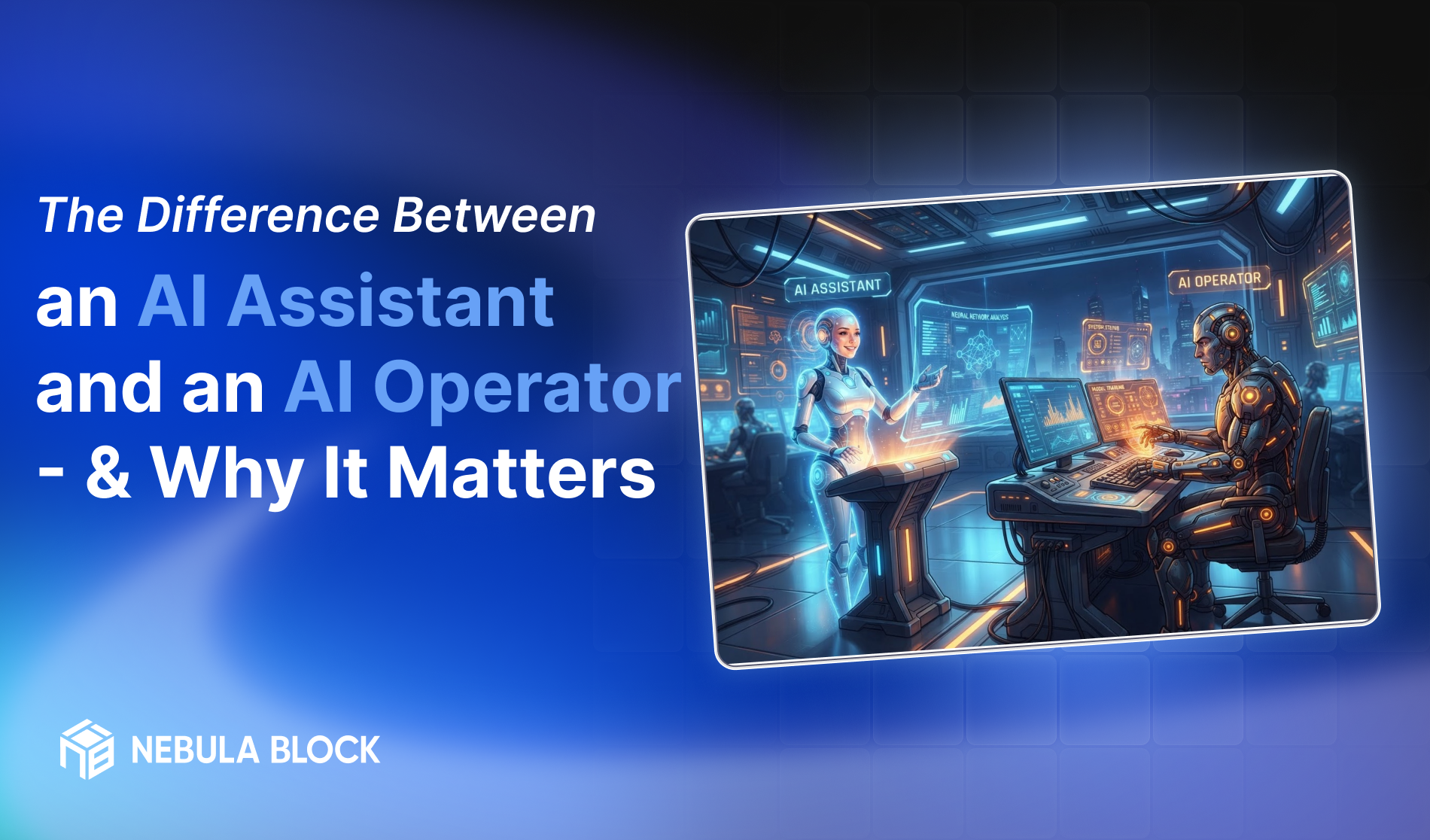
Most companies describe their AI deployment as "we added an AI assistant." Fewer can honestly say they've deployed an AI operator. The distinction sounds like marketing semantics, but it maps to a real architectural line — and which side of that line your system sits on determines what it's actually capable of doing for your business.
The Assistant Model: Reactive, Stateless, Advisory
An AI assistant, in the strict sense, is a request-response system. A user asks a question or gives an instruction; the assistant produces an answer, a draft, or a suggestion; the interaction ends. The next request starts from a mostly blank slate, informed at best by whatever fits in the current conversation's context window.
This model is genuinely useful — drafting an email, summarizing a document, answering a policy question — but it has a structural ceiling. An assistant doesn't hold a persistent, evolving understanding of the business it operates in. It doesn't know that a customer already escalated twice last month unless someone tells it in the current conversation. It can't act on your CRM, your ticketing system, or your payment processor — it can only tell you what it would do if you did those things yourself. Every assistant interaction is, in effect, isolated.
The Operator Model: Persistent, Authorized, Consequential
An AI operator is built around three capabilities an assistant typically lacks: persistent context, permissioned action, and accountability for outcomes.
Persistent context means the system maintains an ongoing understanding of the entities it works with — a customer, an employee, a deal, a device — that survives across sessions and updates as new information arrives, rather than resetting with every new conversation. This is what allows an operator to know, without being told again, that this customer already escalated twice last month.
Permissioned action means the operator doesn't just describe what should happen next — it can actually do it, within defined boundaries: update a record, issue a refund up to a set limit, schedule a follow-up, escalate to a human. This requires an authorization model, not just a capable model — the system needs to know what it's allowed to do on whose behalf, and under what conditions it must stop and ask.
Accountability for outcomes means every action the operator takes is logged, attributable, and reviewable — not just the final answer it gave, but the sequence of context it used and actions it triggered to get there. An assistant's failure mode is a bad answer. An operator's failure mode is a wrong action taken on a real system, which is a fundamentally higher-stakes category of risk — and why the architecture around it has to be held to a higher standard.
Why This Distinction Actually Matters
The practical consequence isn't philosophical — it shows up directly in what a business can deploy AI to do.
A support assistant can draft a response to a customer email. A support operator can read the customer's full history, check whether their issue matches an open bug, issue an authorized refund if it meets policy, and close the ticket — all without a human touching it, escalating only the fraction of cases that fall outside its authorization boundary.
A research assistant can summarize a set of documents you hand it. A research operator maintains an evolving understanding of a research area across weeks of work, knows what's already been investigated and what conclusions were reached, and can flag when new information contradicts an earlier finding — the same synthesis-over-summarization distinction we've written about in building an AI research agent that actually synthesizes.
The gap between these two isn't model quality. A frontier model wrapped in a stateless chat interface is still an assistant. The difference is entirely in the infrastructure wrapped around the model: does it remember, is it authorized to act, and is that action auditable.
What Operator Infrastructure Actually Requires
Building an operator, rather than a more polished assistant, requires investment in a few specific layers that most chatbot deployments skip entirely:
A persistent memory layer that stores what the system has learned about the entities it works with, separate from any single conversation's context window — the subject of its own deep architectural discussion, since naive approaches to memory tend to accumulate noise faster than useful signal.
An authorization and permission model that defines, per action and per context, what the operator can do autonomously versus what requires human sign-off — this is policy infrastructure, not a prompt instruction, and needs to be enforced at the system level rather than requested of the model.
A workflow and tool integration layer that connects the operator to the actual systems of record it needs to act on — the CRM, the ticketing system, the calendar — with each integration scoped to exactly the actions the operator is authorized to take.
An audit and observability layer that records not just outputs but the full decision trail: what context the operator had, what it decided, what it executed, and what the outcome was. This is what makes an operator's actions reviewable after the fact, which matters enormously the first time something goes wrong and someone needs to understand why.
Where Nebula OS Fits
Nebula OS is built around this operator model specifically — a unified context and action layer that gives an AI system persistent memory, permissioned access to the tools and data it needs, and a full audit trail of what it did and why. Rather than bolting workflow automation onto a chat interface after the fact, the assumption from the ground up is that the system needs to remember, needs to be authorized, and needs to be accountable.
Not every use case needs an operator. A one-off drafting task doesn't need persistent memory or action authorization — an assistant is the right tool for that job, and building operator-grade infrastructure around it would be wasted complexity. But the moment a workflow involves recurring context, real consequences, and repeated action over time, the assistant model runs out of road, and the question stops being "which model should we use" and becomes "what infrastructure does this system need around it."
Conclusion
The assistant-versus-operator distinction is ultimately a question of what you're willing to let the system do, and what you've built to make that safe. Most organizations start with assistants because they're simpler to deploy and lower-stakes when wrong. The ones getting the most value from AI today are the ones that have deliberately built the memory, authorization, and audit infrastructure to graduate specific, well-scoped workflows from assistant to operator — not everywhere at once, but exactly where the business case for autonomous action is strongest.
Want to see how Nebula OS's context and authorization layer could turn one of your assistant workflows into a fully operational one? Book a call with our team or explore the documentation to get started.
Learn more at
- Email: contact@nebulablock.com
- Website: nebulablock.com
- Docs: docs.nebulablock.com
- Book a call: nebulablock.com/contact