Building a Long-Term Memory Layer for Your AI Agents
"Just give it a bigger context window" is the most common wrong answer to "why doesn't our agent remember anything." Context windows and memory solve different problems. A context window holds what's relevant to the current task, for the duration of the current task.
Memory holds what's true about the world — this customer, this project, this ongoing relationship — across every future task that touches it. Confusing the two is why so many agent deployments feel forgetful despite running on models with enormous context limits.
Why Context Windows Aren't Memory
A context window is ephemeral by design: it exists for one interaction, and unless something explicitly writes its contents somewhere durable, it disappears the moment the session ends. An agent that relies purely on context-window "memory" has to be re-told everything relevant at the start of every session — which either means the human operator does that work manually, or the system re-retrieves it from scratch each time, at real latency and cost.
Genuine long-term memory means the agent's understanding of an entity — a customer, a project, a piece of infrastructure — persists and accumulates across sessions, gets retrieved selectively when relevant, and updates as new information arrives, without needing to be re-explained.
Three Kinds of Memory an Agent Actually Needs
Human memory researchers distinguish several memory types, and the distinction turns out to be practically useful for agent architecture too, not just cognitive science trivia.
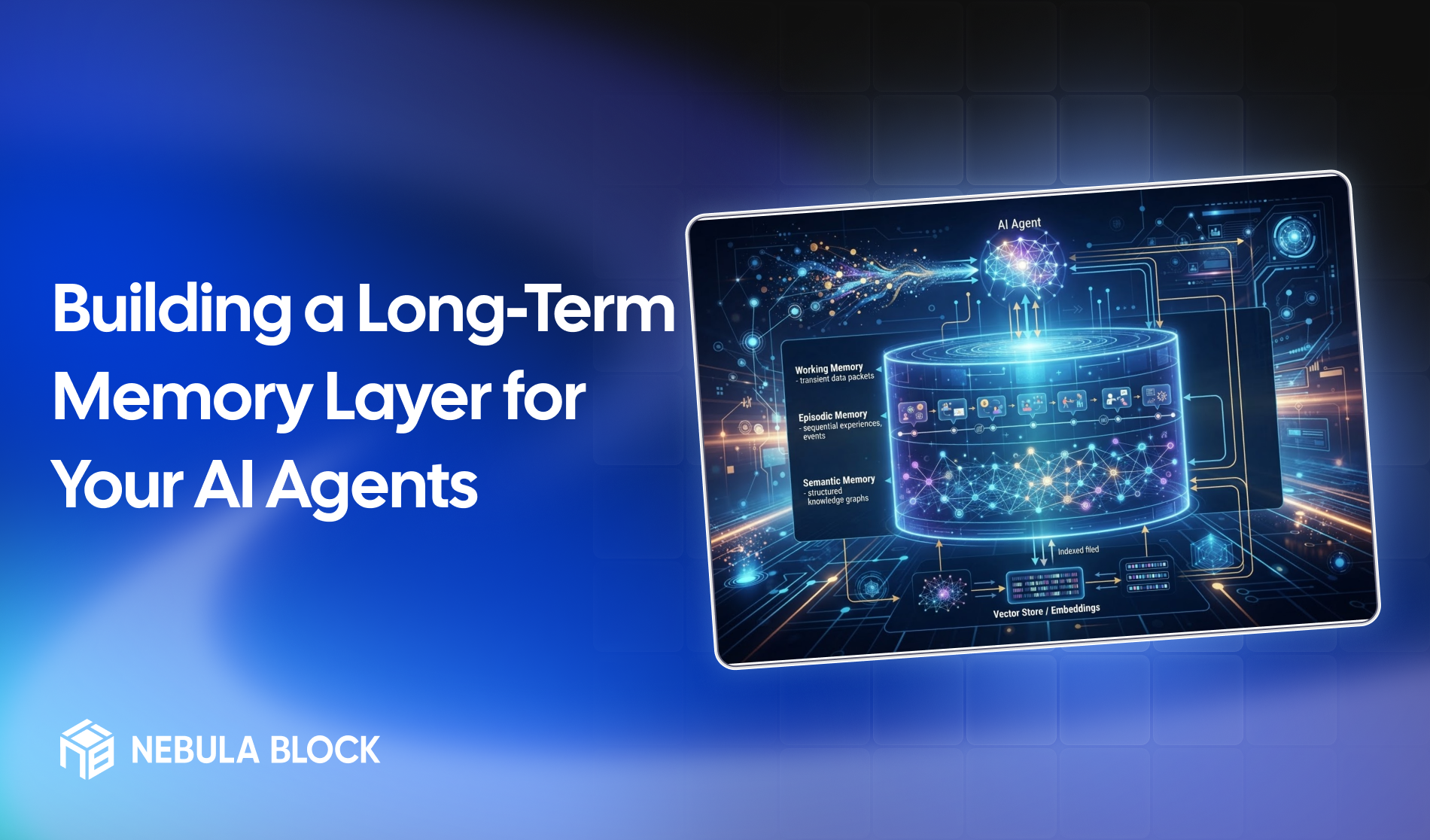
Episodic memory is memory of specific events: "on March 3rd, this customer reported a billing discrepancy and we issued a partial refund." This is memory of what happened, tied to a specific time and context.
Semantic memory is memory of facts and generalizations extracted from those events: "this customer is price-sensitive and has disputed charges twice in the past year." This is memory that's been abstracted away from any single episode into a durable characterization.
Procedural memory is memory of how to do something: "when this type of escalation happens, check the account tier first, then apply the standard retention offer before escalating to a human." This is memory of process, not content.
Most naive memory implementations only capture something like a flat log of episodic events — a running transcript — and expect the model to re-derive semantic and procedural knowledge from that log every time, which is slow, expensive, and inconsistent. A real memory layer explicitly builds and maintains all three, rather than hoping the model reconstructs the higher-order ones on the fly.
The Four Components of a Memory Layer
A memory writer decides what's worth remembering from a given interaction, and in what form. Not everything that happens deserves to become permanent memory — a writer needs a policy for what to keep verbatim (episodic), what to compress into a generalized fact (semantic), and what to discard entirely as noise. Writing everything is not a memory strategy; it's a hoarding strategy that degrades retrieval quality over time as signal gets buried in accumulated trivia.
A memory store holds what's been written, typically across more than one representation — vector embeddings for semantic similarity search, a graph structure for relationships between remembered entities (see how graph databases extend retrieval beyond vector search), and structured fields for facts that benefit from exact lookup rather than fuzzy matching.
A memory retriever decides what to surface for a given task — not everything the system has ever stored about an entity, but the subset that's relevant, recent, and important enough to matter right now. Naive retrieval by similarity alone tends to surface repetitive, low-value memories; production-grade retrieval typically scores by a combination of relevance, recency, and an explicit importance weight assigned at write time.
An update and forgetting policy governs what happens when new information contradicts old memory, and what gets pruned as memory accumulates. Without this, memory stores grow monotonically and eventually degrade retrieval quality (more noise to sift through) and create real risk (an outdated fact resurfacing as if current). Forgetting isn't a missing feature to apologize for — it's a required part of a healthy memory system.
Common Failure Modes in Production
Memory pollution happens when a writer captures too much low-value detail, and retrieval starts surfacing noise alongside signal. This tends to look fine in early testing and degrade slowly and invisibly as the memory store grows — which makes it a dangerous failure mode, since nobody notices until retrieval quality has already meaningfully dropped.
Stale fact resurfacing happens when memory records a fact that was once true and never gets updated or retired when it changes — "customer is on the legacy pricing plan" surfacing months after they migrated. This requires an explicit contradiction-resolution step at write time, not just an accumulation policy.
Retrieval that ignores recency treats a memory from a year ago identically to one from yesterday if they're semantically similar, which is wrong for most business contexts where recent information should generally outweigh old information unless explicitly marked as durable (like a customer's stated preference, versus their most recent order status).
No deletion path becomes a real problem the moment privacy regulation or a customer request requires removing everything the system knows about a specific person. A memory architecture that can't cleanly locate and delete everything tied to one entity is a compliance liability waiting to surface, not just a technical inconvenience.
Where This Fits Into a Broader Agent Architecture
Memory isn't a standalone feature — it's the foundation that makes the assistant-to-operator transition possible at all. An AI operator, by definition, needs to carry context across interactions rather than starting fresh each time; without a real memory layer underneath it, an "operator" is really just an assistant with a longer prompt.
Conclusion
A bigger context window makes an agent more capable within a single interaction. Memory is what makes it capable across all of them — recognizing a returning customer, applying a lesson learned from a past incident, avoiding a mistake it already made once. Building that requires more than a running log: it requires a writer that curates rather than hoards, a store that represents more than one kind of knowledge, a retriever that weighs relevance against recency and importance, and an update policy that treats forgetting as a feature. Skipping any one of these is how you end up with an agent that has plenty of context and still doesn't remember anything that matters.
Want help designing a memory layer that fits your agent's actual workflows, not a generic transcript log? Book a call with our team or explore the documentation to get started.
Learn more at
- Email: contact@nebulablock.com
- Website: nebulablock.com
- Docs: docs.nebulablock.com
- Book a call: nebulablock.com/contact