The Sovereign Infrastructure Checklist: Moving From Public Cloud to Localized Inference
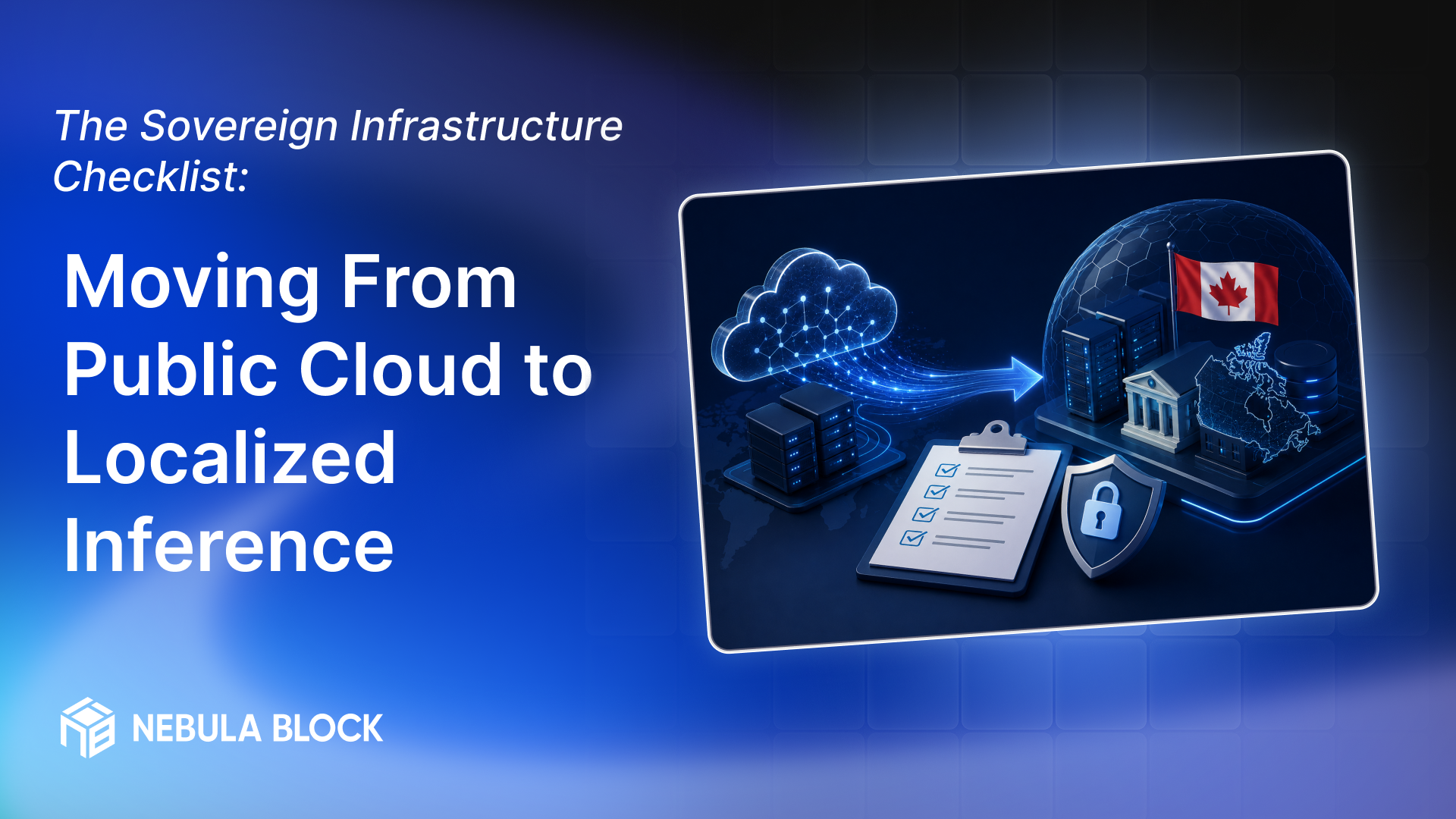
A practical, phase-by-phase checklist for organizations evaluating or executing a shift from public-cloud AI inference (OpenAI, Anthropic API, Azure OpenAI, AWS Bedrock) to on-premises, private-cloud, or sovereign infrastructure.
Key Takeaway: Sovereign AI isn't just about changing an API endpoint — it's an infrastructural and operational shift. Use this playbook to map out every phase of your migration, from compliance to hardware sizing.
Phase 1: Strategy, Compliance & Scope
1. Define What "Sovereignty" Actually Means for You
Before touching hardware, get specific — "data sovereignty" means different things to different stakeholders.
- Identify the core driver: Is it regulatory (GDPR, local residency), contractual (strict client requirements), security (air-gap requirement), cost (predictable spend at scale), or strategic (avoiding vendor lock-in)?
- Determine the required sovereignty level:
- Data Residency: Data stays within a specific jurisdiction, but managed infrastructure is acceptable.
- Data Isolation: No third party processes or touches the data, even within the region.
- Full Air-Gap: Zero external network connectivity allowed.
- Map workloads: Identify which workloads actually require local execution (not everything needs to move — hybrid is often the pragmatic target).
- Sign-off: Get legal and compliance approval on the target state before scoping infrastructure, not after.
2. Data Classification & Regulatory Mapping
- Classify data: Group data into sensitivity tiers (Public, Internal, Confidential, Regulated/PII/PHI).
- Map against frameworks: Align each tier with applicable standards (e.g., GDPR, HIPAA, CCPA, FedRAMP, ITAR, or sector-specific rules).
- Analyze cross-border flows: Identify constraints on where inference can legally happen relative to where data originates.
- Define retention rules: Document strict retention and deletion requirements for prompts, completions, logs, and vector embeddings.
- Auditability: Confirm whether audit trails must be immutable and exportable for compliance reporting.
Phase 2: Architecture & Hardware Planning
3. Model Selection & Licensing
- Choose open-weight models: Select candidate families (Llama, Mistral, Qwen, DeepSeek, Gemma) and explicitly verify that commercial license terms match your use case.
- Benchmark on real tasks: Evaluate models against your actual production tasks rather than relying purely on generic academic leaderboards.
- Balance size vs. hardware:
7B–14Bparameters: Fit well on commodity/entry-level GPUs.70B+parameters orMoEarchitectures: Require dedicated, multi-GPU clusters.
- Adopt a multi-model approach: Route routine/sensitive tasks to smaller local models, while selectively routing non-sensitive tasks to hosted frontier models if hybrid execution is allowed.
- Plan for model updates: Establish an agile evaluation process for integrating new open-weight releases as the ecosystem evolves rapidly.
4. Hardware & Capacity Planning
- Estimate throughput: Calculate required concurrent users, target tokens/sec, and peak vs. average load.
- Select deployment target: On-prem GPU cluster, colocation facility, sovereign regional cloud, or private cloud with dedicated tenancy.
- Size GPU resources: Account for VRAM needed for model weights + KV cache headroom for max context lengths and batch sizes.
- Design for high availability: Ensure N+1 capacity, failover nodes, and eliminate single points of hardware failure.
- Facility readiness: Factor in power delivery, liquid/air cooling capacity, and physical security if deploying on-prem.
- Procurement timelines: Decide between purchase, lease, or colocation — account for multi-month GPU supply chain lead times.
Phase 3: Infrastructure, Networking & Security
5. Inference Serving Stack
- Select a serving engine: Evaluate high-performance frameworks such as
vLLM,TGI,TensorRT-LLM,llama.cpp,SGLang, or a managed private-inference platform. - Apply quantization: Utilize
FP8,INT8, orINT4strategies to optimize latency and hardware costs while preserving model quality. - Autoscaling & gateways: Implement dynamic load-balancing across GPU nodes and deploy an API gateway layer that mimics standard interfaces (e.g., OpenAI-compatible endpoints) to simplify application refactoring.
- Implement caching: Use prompt and semantic caching to eliminate redundant compute cycles.
6. Networking & Access Control
- Topology: Architect isolated VPCs, private links, or fully air-gapped networks.
- Zero-Trust architecture: Enforce strict identity and access management for all services communicating with inference endpoints.
- Disable telemetry: Ensure underlying libraries, serving frames, and container images do not silently send phone-home telemetry to third parties.
- Network segmentation: Isolate inference clusters from the general corporate network using zero-trust firewalls and strict access policies.
7. Security Hardening
- Encryption: Mandate end-to-end encryption in transit (TLS 1.3) and at rest for prompts, logs, and cached outputs.
- Secret management: Utilize dedicated secret vaults for internal API tokens and orchestration keys.
- Vulnerability management: Continuously scan container images, serving stacks, and underlying OS layers for vulnerabilities.
- Mitigate prompt injection: Implement security guardrails to prevent prompt-injection and data-exfiltration attacks, even within closed network perimeters.
- Incident response: Define clear internal escalation paths for outages, given the absence of a third-party vendor SLA.
Phase 4: Operations, Costs & Migration
8. Observability & Operations
- Performance metrics: Instrument dashboards for real-time tracking of GPU utilization, memory bandwidth, latency (TTFT, ITL), and request throughput.
- Compliance logging: Build immutable audit logging pipelines aligned with regulatory mapping.
- Evaluation pipelines: Establish continuous quality checks to detect silent model degradation or output drift.
- Rollback plan: Maintain instant rollback mechanisms for model weight or serving stack updates.
9. Team & Operational Readiness
- Skill gap assessment: Audit team expertise in MLOps, GPU infrastructure management, and quantization tuning.
- Build vs. Buy decision: Choose between fully managing the stack in-house or partnering with a sovereign inference platform provider.
- On-call rotation: Set up internal engineering coverage to manage hardware and system incidents 24/7.
- Developer enablement: Train application developers on key technical differences (such as context window handling and latency profiles) between public cloud APIs and self-hosted models.
10. Cost Modeling
- Build a genuine TCO comparison: hardware amortization + power + cooling + real estate/colo + staffing vs. current API spend at projected scale
- Identify the breakeven volume where self-hosting beats pay-per-token pricing (this is workload-specific — high-volume, steady-state traffic favors self-hosting; spiky/low-volume often doesn't)
- Account for underutilization — GPUs sitting idle overnight or between peaks are sunk cost, unlike elastic cloud billing
- Model the cost of the migration itself (parallel-run period, engineering time, retraining/re-prompting for model differences)
11. Migration Execution
- Run a pilot on a single, non-critical workload before full migration
- Parallel-run old and new systems to compare output quality, latency, and cost before cutover
- Build an abstraction layer in application code so the inference backend can be swapped without rewriting business logic
- Define clear rollback criteria and a rollback plan if the new stack underperforms
- Migrate workloads in order of sensitivity/urgency, not order of convenience — get the highest-value sovereignty win first
- Communicate timeline and expectations to internal stakeholders whose tools depend on inference latency/quality
12. Ongoing Governance
- Establish a recurring review of the build-vs-buy decision as open models and sovereign cloud offerings evolve
- Keep a model evaluation cadence so you're not stuck on an aging open-weight model
- Revisit the compliance mapping (Section 2) whenever regulations or contracts change
- Document architecture decisions so the rationale for sovereignty tradeoffs survives team turnover
A Note on Hybrid Approaches
Full sovereignty is not all-or-nothing. Many organizations land on a hybrid model: sensitive or regulated workloads run on local/sovereign infrastructure, while non-sensitive, latency-tolerant, or experimental workloads continue to use hosted frontier models where the quality gap matters more than the sovereignty gap. Treat this checklist as a menu to apply per-workload, not a single binary migration.
Learn more at
- Email: contact@nebulablock.com
- Website: nebulablock.com
- Docs: docs.nebulablock.com
- Book a call: nebulablock.com/contact