Why Enterprise AI Projects Stall at Production (And the Architecture Secrets that Fix It)
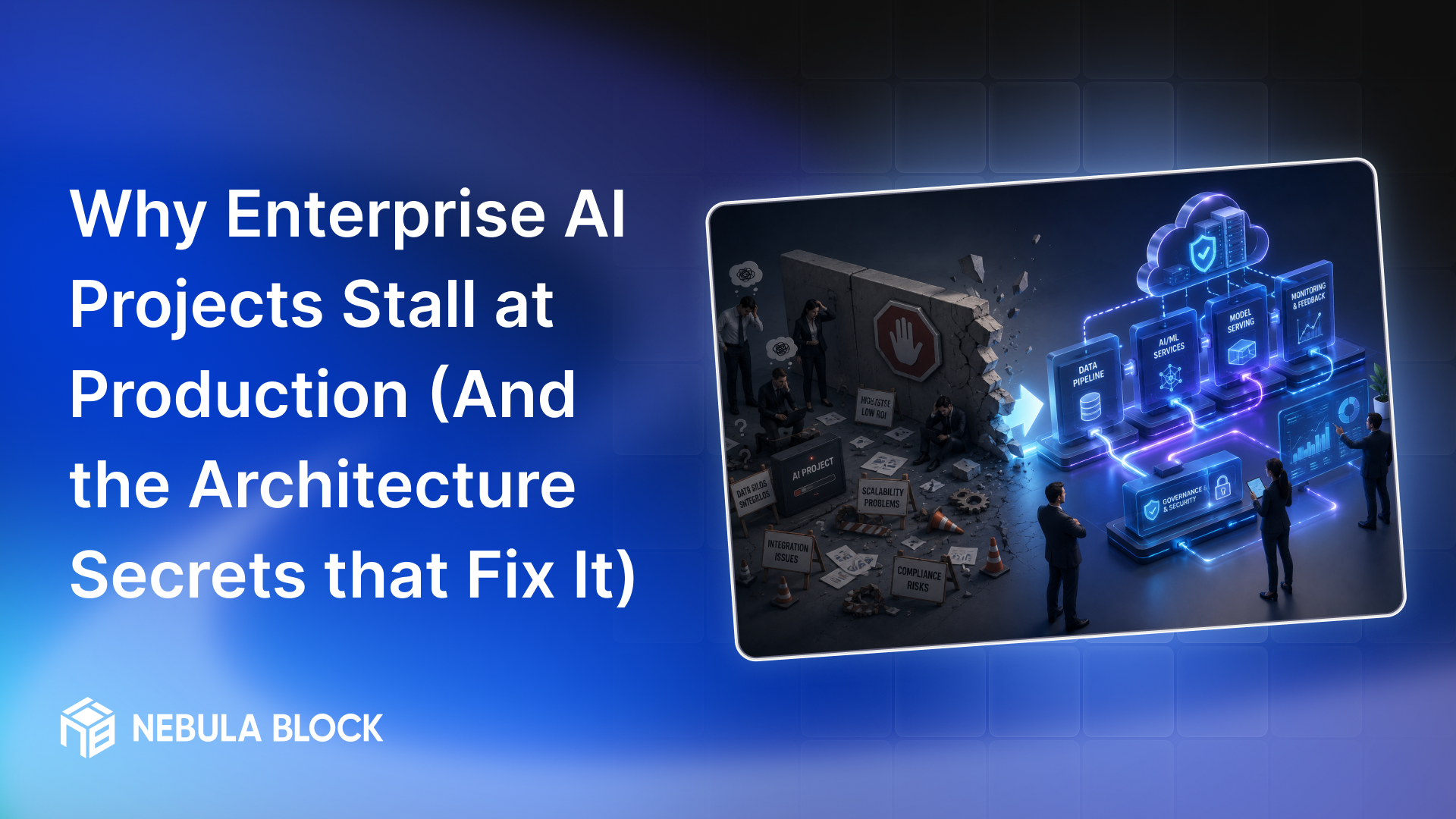
If you've watched a promising AI pilot die a slow death somewhere between the demo and the rollout, you're not alone — you're the majority.
Roughly 9 in 10 organizations use AI in at least one business function, yet only about 6% capture significant enterprise value from it, with an estimated 80–95% of AI projects failing to deliver their promised return. A meta-analysis spanning 65 documented enterprise AI initiatives found that:
- 1/3 of projects are abandoned before they ever reach production.
- Over 25% make it to production but fail to deliver expected value.
- Nearly 20% run continuously but never recoup their costs.
The Uncomfortable Truth: The failure is almost always in strategy, data readiness, and organizational change management — not in the AI itself. The models work. The demos work. What breaks is everything between the demo and durable production use — and that gap is architectural, not algorithmic.
Here is where projects actually stall, and the design patterns that get teams unstuck.
Where Projects Actually Die
1. The Data Foundation Was Never Built
Gartner forecasts that 60% of AI projects unsupported by AI-ready data will be abandoned through 2026. Teams jump straight to model selection and prompt engineering while the data feeding the system is scattered across incompatible systems, undocumented, or simply not clean enough to trust. A model can only be as good as what it's fed, and "we'll fix the data pipeline later" is how pilots die quietly six months in.
2. There's No Bridge Between Prototype and Production
The average organization scraps 46% of AI proof-of-concepts before reaching production, and only 48% of AI projects make it into production at all — with an average of 8 months from prototype to production for the ones that do.
That 8-month gap is almost never a modeling problem. It's the absence of the unglamorous infrastructure:
- Evaluation harnesses
- Deployment pipelines
- Real-time monitoring
- Rollback paths
These are elements a notebook demo never needed, but a production system cannot survive without.
3. Success Was Never Defined in Measurable Terms
Projects that can't say what "working" means in dollars, hours saved, or error-rate reduction can't be defended when budget season comes around or when a skeptical VP asks for proof. The projects that succeed share a common thread: they defined success upfront and invested in their data foundation before touching a model.
4. Governance and Ownership Are Unclear
57% of infrastructure and operations leaders report at least one AI project failure in their own ranks. It almost always comes down to the same question: Who formally owns what, and does the group hold together under the pressure of going live? A model with no clear owner for its outputs, its failure modes, or its maintenance is a model that gets quietly switched off the first time it embarrasses someone.
5. Executive Sponsorship Fades Before Value Shows Up
The recurring causes across independent studies are consistent: unclear definitions of success, weak data foundations, poor integration into real workflows, chasing technology rather than business outcomes, and fading executive sponsorship. AI value curves are slower than demo curves. If sponsors expect demo-day magic to translate into month-one ROI, they lose patience exactly when the critical integration work is underway.
The Architecture Fixes
None of the fixes below are exotic. They're the boring plumbing that separates the 5–20% of projects that make it from the majority that don't.
Fix 1: Treat Data Infrastructure as the Actual Project
Before selecting a model, build the pipeline that gets clean, current, and access-controlled data in front of it — and instrument that pipeline so you know when it breaks. This is unglamorous, but it is the highest-leverage work in the entire initiative. Projects that invest here first are disproportionately represented among the minority that succeed.
Fix 2: Build the "Boring Middle" Before You Need It
The gap between prototype and production is closed by infrastructure, not model quality:
- Evaluation harnesses: Score outputs against real business criteria, not vibes.
- Staged rollout paths: Implement shadow mode → limited users → full deployment so failure is caught before it gets expensive.
- Monitoring & drift detection: Catch silent quality decay before customers or auditors do.
- Rollback mechanisms: Ensure a bad model version or prompt change doesn't require a war room.
Build this scaffolding for your first pilot, not your fifth — it's what turns "we should really operationalize this" into a repeatable capability.
Fix 3: Define Success in Numbers Before Demos
Every project needs a measurable target agreed upon before the build starts:
- Cost per resolved ticket
- Hours reclaimed per employee per week
- Error rate versus the human baseline
Vague goals produce vague accountability, and vague accountability is how 42% of initiatives get quietly written off when budgets tighten.
Fix 4: Assign Real Ownership (Including for Failure)
Someone needs to own the model's outputs the way a product owner owns a feature — accountable for what it does wrong, not just what it does right. This includes an explicit incident response path: what happens when the model gives a customer the wrong answer, and who gets paged.
Fix 5: Architect for a Value Curve, Not a Demo Curve
Set sponsor expectations around the real timeline — most organizations that reach durable production report roughly 8 months from prototype to production. Build a midpoint checkpoint that shows leading indicators (e.g., data quality improving, evaluation scores trending up) rather than asking sponsors to wait silently for a lagging ROI number.
Fix 6: Design for Integration Into Existing Workflows
Poor integration into real workflows is one of the most consistent causes of failure. A model that requires people to leave their existing tools to get value from it will be abandoned, regardless of how good its outputs are. The architecture question isn't just "does the model work?" — it's "does it show up inside the tool someone already has open?"
The Pattern Underneath All of It
Key Takeaway: AI failure is organizational, not technical, and the fix is governance and scope discipline, not more model spend.
Every fix above is an investment in the parts of the system that don't show up in a demo: data plumbing, evaluation infrastructure, ownership, and integration into how people actually work.
That's a less exciting story than "we deployed a frontier model," but it's the story every project in the surviving minority can tell. If your AI initiative is stalling, the model is very likely not the problem. Look at what's underneath it.
Learn more at
- Email: contact@nebulablock.com
- Website: nebulablock.com
- Docs: docs.nebulablock.com
- Book a call: nebulablock.com/contact