The Graph RAG Advantage: Why Hierarchical Knowledge Stores Outperform Flat Contexts
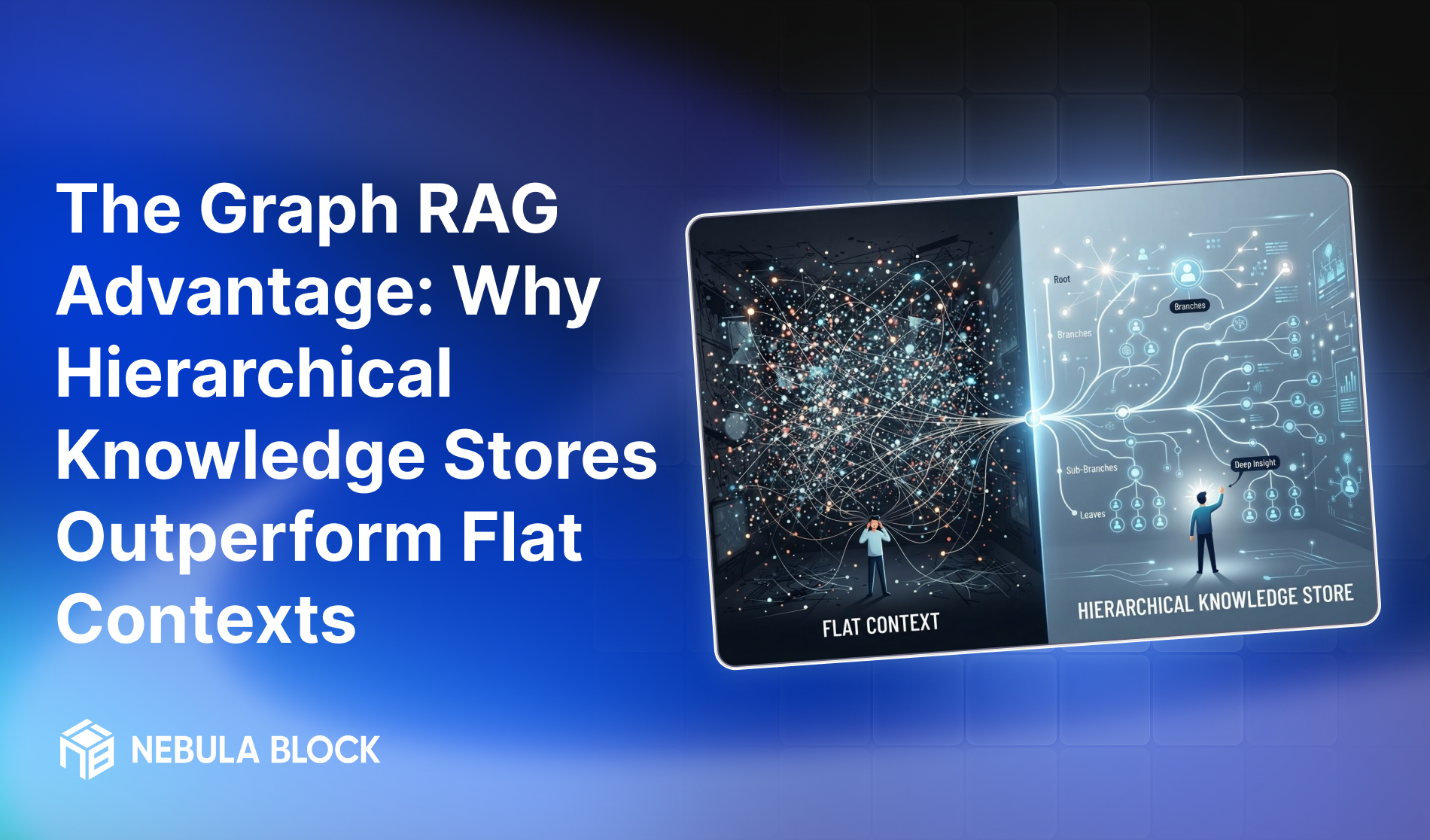
Enterprise data rarely exists as isolated pieces of information. Contracts, policies, employees, vendors, regulations, and operational records are connected through complex relationships.
Traditional Retrieval-Augmented Generation (RAG) systems typically split documents into chunks, convert them into embeddings, and retrieve the most semantically relevant chunks for a query. This approach works well for many straightforward questions, but it can become more challenging when an answer depends on relationships across multiple documents or requires a broader understanding of the knowledge base.
This is where Graph RAG can provide an additional layer of structure.
Instead of treating enterprise knowledge as a collection of independent text chunks, Graph RAG represents entities, relationships, and higher-level communities in a structured knowledge graph. Combined with hierarchical retrieval and source documents, this approach can help AI systems work with more context around how information is connected.
The Limits of Flat Context RAG
A conventional RAG architecture often looks like this:
User Query
    |
    v
Query Embedding
    |
    v
Vector Database
    |
    v
Relevant Chunks
    |
    v
LLM Context
    |
    v
Generated Answer
The system retrieves passages that are semantically relevant to the user's question and provides them to the model.
For simple questions, this can be highly effective.
For example:
"What is the termination period in Vendor A's contract?"
The answer may exist in one or two relevant passages.
However, enterprise questions are often more complex:
"What are the major compliance risks across our Q3 vendor contracts?"
The answer may require information from many contracts, vendors, jurisdictions, regulations, and departments.
Three challenges become particularly important.
1. Chunk Fragmentation
Information about the same entity may be distributed across different sections of a document or across multiple documents.
One section may describe a vendor, another may define its data-processing obligations, while another contains termination conditions.
When these are stored primarily as independent chunks, the relationships between them must be reconstructed during retrieval and generation.
2. Global Queries
Some questions require the system to identify patterns across an entire knowledge base rather than retrieve a single relevant passage.
A vector search system can retrieve relevant chunks, but the model may still need to determine how those fragments relate to one another before producing a complete answer.
3. Context Overload
Retrieving more chunks does not automatically produce better answers.
If a large number of passages are inserted into the model's context window, relevant information can become harder to identify and connect. This is particularly important for long-context applications where the model must reason across many pieces of retrieved information.
How Graph RAG Adds Structure
Graph RAG approaches the problem by explicitly representing entities and relationships.
A simplified knowledge graph might look like:
(Vendor A)
     |
     | PROVIDES
     v
(Cloud Service)
     |
     | SUBJECT_TO
     v
(Regulation X)
A larger enterprise graph could contain relationships such as:
Employee → WORKS_FOR → Company

Company → SIGNS → Contract

Contract → INVOLVES → Vendor

Contract → SUBJECT_TO → Regulation

Regulation → APPLIES_TO → Jurisdiction
This structure allows retrieval to consider not only whether information is semantically similar to a query, but also how entities are connected.
Graph RAG does not necessarily replace vector search. In many architectures, vector retrieval and graph retrieval can work together.
Vector search helps locate relevant text.
The knowledge graph helps identify relationships between entities.
The original documents provide the underlying evidence.
The LLM then combines these sources to construct the final response.
Hierarchical Knowledge for Large Enterprise Data
Large knowledge graphs can contain millions of entities and relationships. Searching every node for every question is not always practical.
A hierarchical structure can help organize information at different levels of abstraction.
Level 0: Global Knowledge
This level contains high-level summaries of major domains within the enterprise.
Enterprise
├── Legal
├── Finance
├── Human Resources
├── Vendors
└── Operations
Level 1: Communities
Each domain can contain more specific communities.
Legal
├── Employment
├── Vendor Contracts
├── Privacy
└── Intellectual Property
Level 2: Atomic Knowledge
The lowest level contains individual entities, relationships, clauses, and supporting facts.
Vendor A
   |
   └── HAS_CONTRACT → Contract 2026
                         |
                         └── SUBJECT_TO → Regulation X
This hierarchy allows a retrieval system to move from broad context toward specific evidence.
A Practical Retrieval Flow
A simplified Graph RAG pipeline can look like this:
User Query
    |
    v
Identify Relevant Domain
    |
    v
Select Relevant Community
    |
    v
Traverse Related Entities
    |
    v
Retrieve Supporting Documents
    |
    v
Construct Context
    |
    v
LLM Inference
Consider a question such as:
"Which vendors have contracts involving similar data-processing obligations?"
The system may first identify the relevant privacy and vendor communities. It can then traverse relationships between vendors, contracts, clauses, and regulations before retrieving the underlying documents.
This changes the retrieval problem from simply finding similar text to understanding which pieces of knowledge are connected.
Graph RAG vs. Flat Context RAG
| Capability | Flat Context RAG | Graph RAG |
|---|---|---|
| Semantic search | Core capability | Can be combined with graph retrieval |
| Simple factual queries | Well suited | Well suited |
| Explicit relationships | Limited | Core capability |
| Cross-document relationships | Requires reconstruction | Can be represented explicitly |
| Multi-hop queries | More challenging | Natural fit |
| Global knowledge synthesis | Can require many chunks | Hierarchical structures can help |
| Implementation complexity | Lower | Higher |
| Data preparation | Chunking + embeddings | Entity extraction + graph construction |
This does not mean Graph RAG is always the better choice.
For relatively simple knowledge bases and straightforward questions, conventional vector-based RAG may be sufficient.
Graph RAG becomes more relevant when relationships, multi-hop reasoning, and broader knowledge structures are important to the task.
Infrastructure Considerations
Graph RAG also introduces additional infrastructure requirements.
A production system may need:
- Document storage
- Embedding models
- Vector databases
- Graph databases
- Entity and relationship extraction
- Graph construction pipelines
- LLM inference
- Retrieval orchestration
- GPU infrastructure
The required infrastructure depends on the size and complexity of the knowledge base.
As enterprise workloads grow, compute may be required not only for final LLM inference but also for document processing, embedding generation, entity extraction, graph construction, indexing, and continuous updates.
This makes the underlying AI infrastructure an important component of a production Graph RAG architecture.
The Key Takeaway
Flat Context RAG and Graph RAG are not necessarily competing approaches.
Traditional vector-based RAG is effective when the primary task is finding semantically relevant passages.
Graph RAG adds another dimension by representing relationships and knowledge structures explicitly.
A practical enterprise architecture can combine both:
             Enterprise Data
                   |
        +----------+----------+
        |                     |
        v                     v
 Document Store        Knowledge Graph
        |                     |
        v                     v
 Vector Retrieval      Graph Retrieval
        |                     |
        +----------+----------+
                   |
                   v
           Context Construction
                   |
                   v
              LLM Inference
                   |
                   v
             Grounded Answer
The goal is not to retrieve the maximum amount of information.
It is to retrieve the right information, with enough structure and supporting evidence for the model to understand how the pieces fit together.
As enterprise AI systems work with increasingly interconnected data, combining semantic retrieval with structured knowledge can provide another path toward more context-aware retrieval and generation.
Learn more at
- Email: contact@nebulablock.com
- Website: nebulablock.com
- Docs: docs.nebulablock.com
- Book a call: nebulablock.com/contact