Reducing Token Churn: How Nebula OS Prunes Irrelevant Enterprise Data Pre-Inference
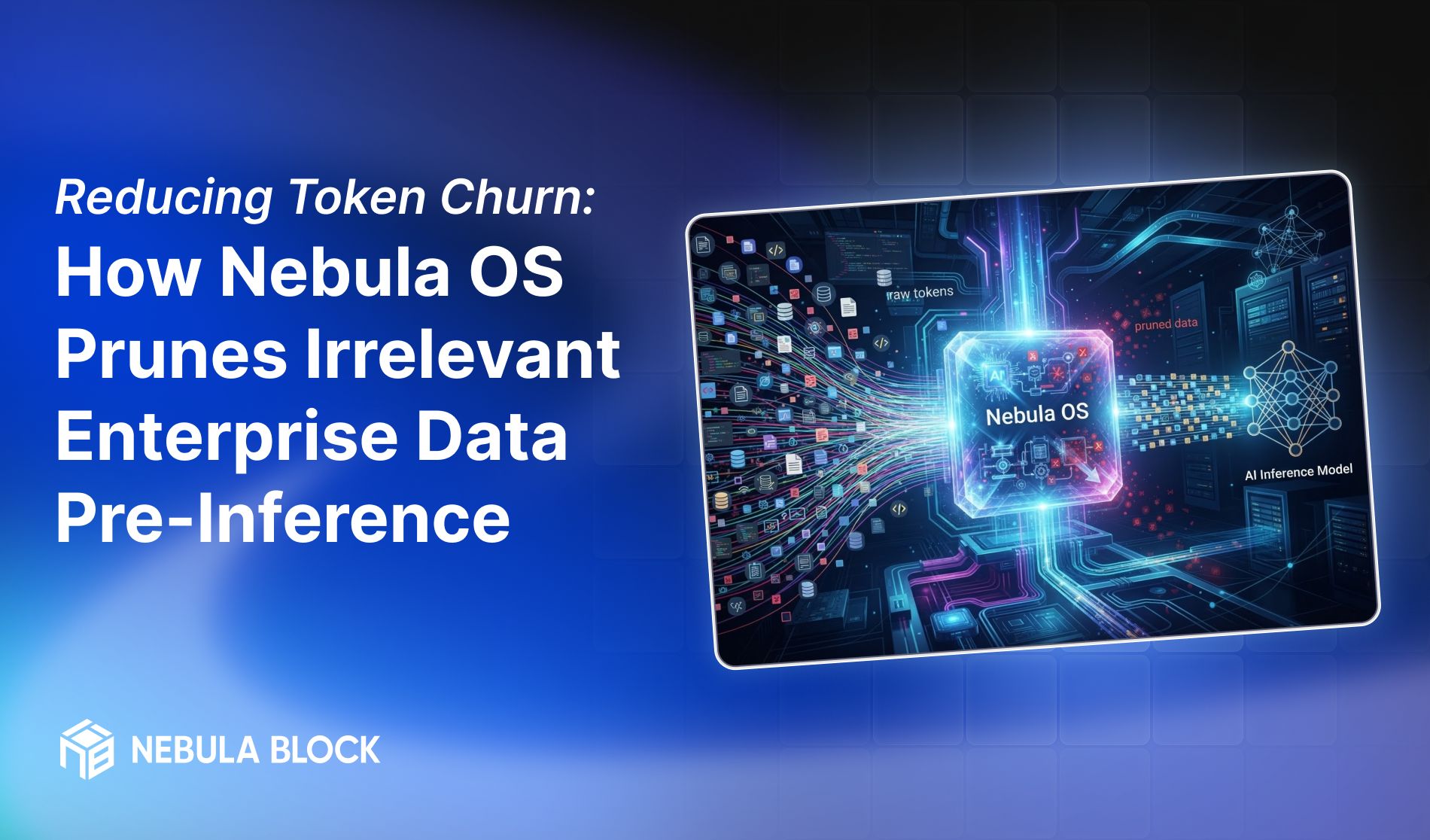
In enterprise AI deployments, Token Churn—spending compute resources and API dollars on irrelevant, noisy context—is the leading driver of inflated Total Cost of Ownership (TCO) and severe response latency.
Nebula OS eliminates this overhead through Pre-Inference Context Pruning, an automated pipeline that strips out fluff and redundant context before data ever reaches the Large Language Model (LLM).
The 3-Tier Pruning Engine
Rather than dumping raw retrieval results straight into the LLM’s context window, Nebula OS passes data through an aggressive, multi-stage filtration pipeline:
[Raw Retrieved Chunks]
       │
       ▼  Step 1: Semantic Entropy Filtering (Deduplication & Density Check)
[Deduplicated Context]
       │
       ▼  Step 2: Cross-Encoder Re-Ranking & Scoring (Relevance Verification)
[Ranked Passages]
       │
       ▼  Step 3: Attention-Aware Token Slicing (Granular Token Pruning)
[Optimized Context Window] ──► [LLM Inference]
1. Semantic Entropy Filtering (Passage Level)
Raw retrieved context often contains duplicate documents or low-value filler text. The first layer evaluates information entropy across passages to eliminate redundant chunks and discard low-density text fragments before deeper processing.
2. Cross-Encoder Re-Ranking (Sentence Level)
Once deduplicated, Nebula OS passes the remaining passages through lightweight, ultra-fast re-ranking models (such as BGE-Reranker or Cohere Rerank). These cross-encoders score actual sentence-level relevance against the input prompt, dropping sentences that do not directly address the query.
3. Attention-Aware Token Slicing (Token Level)
At the most granular level, Nebula OS analyzes LLM attention-map patterns to trim context at the individual token boundary. The engine strips away filler words, formatting fluff, and unnecessary transitional phrases while preserving key anchor tokens that hold core semantic meaning.
Enterprise Impact
By stripping context noise pre-inference, Nebula OS transforms raw data payloads into highly concentrated context windows—delivering immediate operational and financial advantages:
- 50–70% Reduction in API Costs: Prevents wasting budget on sending bloated 32k-token prompts just to generate a 100-word response.
- Faster Time-To-First-Token (TTFT): Significantly smaller context payloads accelerate the LLM's prefill phase, reducing initial response latency.
- Enhanced Accuracy & Lower Hallucinations: Eliminates context noise, contradictions, and irrelevant information, ensuring the model stays strictly focused on authoritative facts.
Learn more at
- Email: contact@nebulablock.com
- Website: nebulablock.com
- Docs: docs.nebulablock.com
- Book a call: nebulablock.com/contact