The Future Isn't About Knowing How to Use AI — It's About Knowing How to Evaluate It
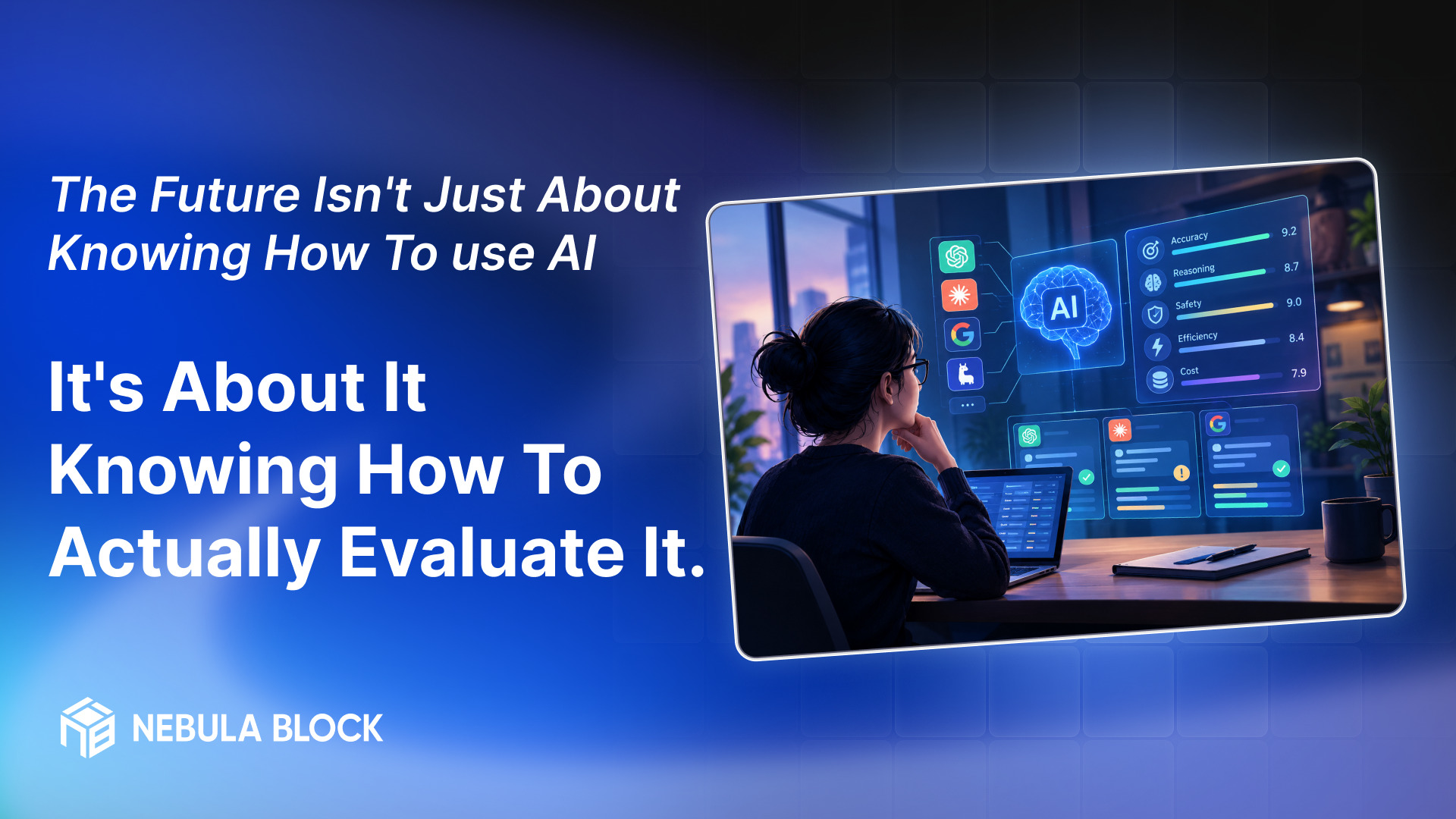
For the past few years, the professional advice has been simple: learn to use AI. Take the course, learn the prompt patterns, get comfortable with the chat window. That advice isn't wrong, but it's already out of date. The tools have gotten easy enough that "knowing how to use AI" is no longer a differentiator — it's a baseline, roughly as impressive as knowing how to use a search engine or a spreadsheet.
The differentiator that's emerging is different in kind: knowing how to evaluate AI. Not just prompting a model to get an answer, but knowing whether the answer is any good, where it's likely to be wrong, and what to check before you act on it.
Usage is getting commoditized. Judgment isn't.
Every model provider is racing to make their systems easier to use — better defaults, more autonomous agents, less prompt engineering required. That's good for adoption, but it also means "I know how to get AI to do things" stops being a scarce skill. What doesn't get commoditized is the ability to look at an AI-generated output — a piece of code, a legal summary, a financial model, a customer email — and know whether it's correct, complete, and appropriate for the situation.
This is a genuinely different skill from usage. It looks less like prompt engineering and more like editing, auditing, and quality control. It requires domain expertise (you can't evaluate a contract clause you don't understand), a working model of how the AI is likely to fail (hallucinated citations, confident-sounding wrong math, stale information, subtly biased framing), and the discipline to actually check rather than rubber-stamp.
Evaluation is a skill, not an instinct.
Most people currently evaluate AI output by vibes: does it sound right, is it formatted nicely, does it match what I expected? That's a weak filter, because modern models are very good at sounding right even when they're wrong. Real evaluation looks more like: verifying claims against a primary source, running the code instead of reading it, asking the model to show its reasoning and checking the reasoning rather than just the conclusion, and building small test cases that would catch the specific failure modes common to that task.
Organizations that take AI seriously are starting to formalize this. Teams are building evaluation rubrics for AI-assisted work the same way they'd build a code review checklist. Some are running structured "red team" passes on AI outputs before they ship. The vocabulary of software evaluation — test coverage, regression testing, adversarial testing — is migrating into how people check AI-generated work in law, marketing, finance, and operations.
What this means practically.
If you're building a career or a team around AI-assisted work, the highest-leverage thing to invest in isn't a longer prompt library. It's developing (and teaching) a sharper sense for where a given AI system is trustworthy and where it isn't, plus concrete habits for verification: cross-checking sources, spot-testing outputs, and knowing when a task genuinely needs a human in the loop versus when it doesn't.
The people and organizations that get good at this will move faster than everyone else — not because they use AI more, but because they can trust their own judgment about when to trust it.
Teams evaluating AI output at scale still need infrastructure that doesn't get in the way — that's what we build.
Learn more at
- Email: contact@nebulablock.com
- Website: nebulablock.com
- Docs: docs.nebulablock.com
- Book a call: nebulablock.com/contact