Every Major Enterprise AI Platform Benchmarked (2026)
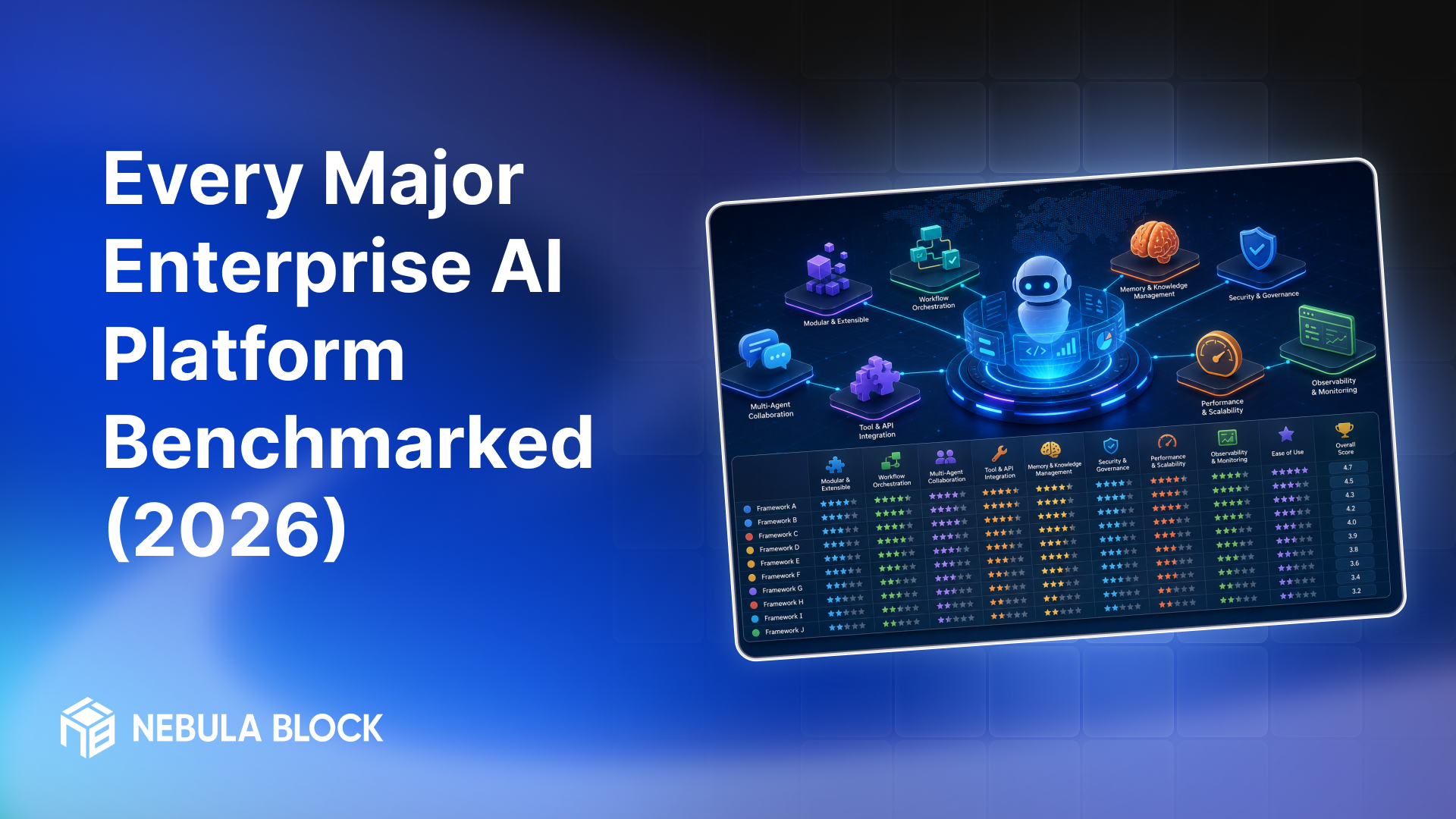
Quick answer: There is no single "best" enterprise AI platform in 2026 — the field has split by strength. Microsoft Copilot Studio / Azure AI Foundry leads for Microsoft-native organizations.
Salesforce Agentforce leads for CRM-resident data. Google's Gemini Enterprise Agent Platform (the 2026 rebrand of Vertex AI) leads for ML-intensive and multimodal workloads.
AWS Bedrock AgentCore leads for multi-model flexibility. IBM watsonx and ServiceNow lead for regulated industries and IT/HR operations, respectively. The right pick depends on where your data already lives and how much governance your industry requires, not on a universal ranking.
Here's how they actually compare, criterion by criterion.
Why "Benchmarking" These Platforms Is Different From Benchmarking Models
Model benchmarks measure a narrow thing: accuracy on a fixed set of tasks. Enterprise platform benchmarks have to measure something messier — because the platform's job isn't just running a model, it's providing the five layers a production deployment actually needs: model access, fine-tuning and RAG tooling, orchestration, governance, and integration with the rest of the enterprise stack.
Two platforms can use the identical underlying model and still perform completely differently for a given company, because the deciding factor is usually integration depth and governance fit — not raw model quality. This is also why so many 2026 platforms now converge on the same handful of foundation models under the hood while competing hard on everything wrapped around them.
Platform-by-Platform Comparison
Microsoft Copilot Studio / Azure AI Foundry
Best for: Microsoft-native organizations. Azure AI Foundry's defining advantage is depth of Microsoft 365 integration and a model catalog that extends well beyond OpenAI — spanning Llama, Mistral, DeepSeek, Cohere, and Anthropic models through an expanded partnership. For enterprises where legal has already approved Azure over OpenAI-direct, Foundry is often the path of least resistance, especially for regulated industries needing the Azure compliance wrapper around frontier models.
Google Gemini Enterprise Agent Platform (formerly Vertex AI)
Best for: ML-intensive, multimodal, and cloud-native GCP shops. Google's 2026 rebrand consolidated Vertex AI into four pillars — build, scale, govern, optimize — adding Agent Studio for low-code authoring, a persistent cross-session Memory Bank, and dedicated governance primitives (Agent Identity, Agent Gateway). It's the strongest option when multimodal processing or heavy ML/data-science workloads are core to the use case.
AWS Bedrock AgentCore
Best for: Multi-model flexibility and AWS-native infrastructure teams. Bedrock's differentiator is model breadth — Claude, Llama, Mistral, and Amazon's own Nova models through one unified API — paired with a more modular AgentCore architecture. It suits teams that want to avoid single-vendor model lock-in while staying inside AWS infrastructure they already operate.
Salesforce Agentforce
Best for: CRM-native autonomous workflows. Agentforce (now in its 360 iteration) routes reasoning through Salesforce's Atlas Reasoning Engine and the Einstein Trust Layer, with Claude as a primary reasoning backend under that trust layer. It's the default choice when customer data and workflows already live in Salesforce, since it avoids duplicating that data into a separate agent platform.
IBM watsonx
Best for: Regulated industries. watsonx differentiates on compliance tooling — including EU AI Act support and IP indemnification — plus over 700 pre-built connectors. Financial services and healthcare organizations tend to shortlist watsonx first specifically because the audit and governance documentation ships built-in rather than needing to be assembled in-house.
ServiceNow AI Platform
Best for: IT and HR operations. ServiceNow's AI Control Tower is built to govern agents across departments rather than within a single function, which makes it a strong fit for internal operations use cases — ticket routing, HR case management — rather than customer-facing agent deployments.
SAP Joule and Oracle AI Agent Studio
Best for: Organizations already standardized on SAP or Oracle ERP. Both increasingly route reasoning through third-party frontier models (SAP Joule uses Claude as a primary reasoning engine) rather than building proprietary models, reflecting a broader 2026 pattern: platform competition is happening at the orchestration and governance layer, not the model layer.
Developer-Grade Options: LangGraph Platform, Cohere Coral, CrewAI Enterprise
Best for: Teams building custom agents rather than buying pre-built ones. These sit a level below the packaged platforms above, trading pre-built business workflows for stronger observability, durable execution, and provider-agnostic model access. LangGraph Platform in particular is frequently cited for the strongest observability and debugging tooling among developer-grade options.
The Decision Framework That Actually Works
Rather than a single ranked list, five questions consistently determine the right platform for a given enterprise:
- Where does your data already live? Salesforce-resident data points to Agentforce; an M365 estate points to Copilot Studio; a GCP-heavy data science org points to Gemini Enterprise.
- What's your regulatory exposure? EU AI Act, financial services, or healthcare privacy obligations point toward IBM watsonx or ServiceNow, both of which ship audit-ready governance out of the box.
- Are you building agents or deploying pre-built ones? Teams writing custom agent logic get more value from developer-grade infrastructure (Bedrock, Vertex, LangGraph Platform); teams wanting fast time-to-value get more from packaged platforms like Agentforce or ServiceNow.
- Do you need multi-model flexibility, or is single-vendor fine? Bedrock and LangGraph Platform are explicitly provider-agnostic; Gemini Enterprise is Gemini-first; Copilot Studio defaults to Azure-hosted models with growing Anthropic support.
- What's your cloud provider already? Fighting your existing cloud provider's native AI stack tends to create integration friction that compounds over time — AWS shops generally get more from Bedrock, GCP shops from Vertex/Gemini Enterprise, and so on.
Frequently Asked Questions
- Which enterprise AI platform is the most widely adopted in 2026? Adoption splits heavily by existing infrastructure rather than converging on one leader. Microsoft Copilot Studio has the deepest reach into organizations already on Microsoft 365; Salesforce Agentforce leads CRM-centric deployments; AWS Bedrock and Google's Gemini Enterprise platform lead among cloud-native engineering teams.
- Do these platforms use different AI models, or the same ones? Increasingly the same ones. Several packaged platforms — including SAP Joule and Salesforce Agentforce — now route reasoning through Claude as a primary backend, even though the platforms compete directly. Differentiation has shifted from the model layer to orchestration, governance, and integration depth.
- Is it possible to use more than one enterprise AI platform at once? Technically yes, but it multiplies governance overhead: each platform maintains its own console, memory system, and audit trail. Most organizations find that consolidating onto one primary platform, rather than mixing several, produces a cleaner governance story.
- How should a company evaluating these platforms start? Start with where sensitive data already lives and what regulatory obligations apply — those two factors eliminate most of the list before feature comparisons even come into play.
Learn more at
- Email: contact@nebulablock.com
- Website: nebulablock.com
- Docs: docs.nebulablock.com
- Book a call: nebulablock.com/contact