Data Gravity in the AI Era: Why Moving the Model to Your Data Wins at Scale
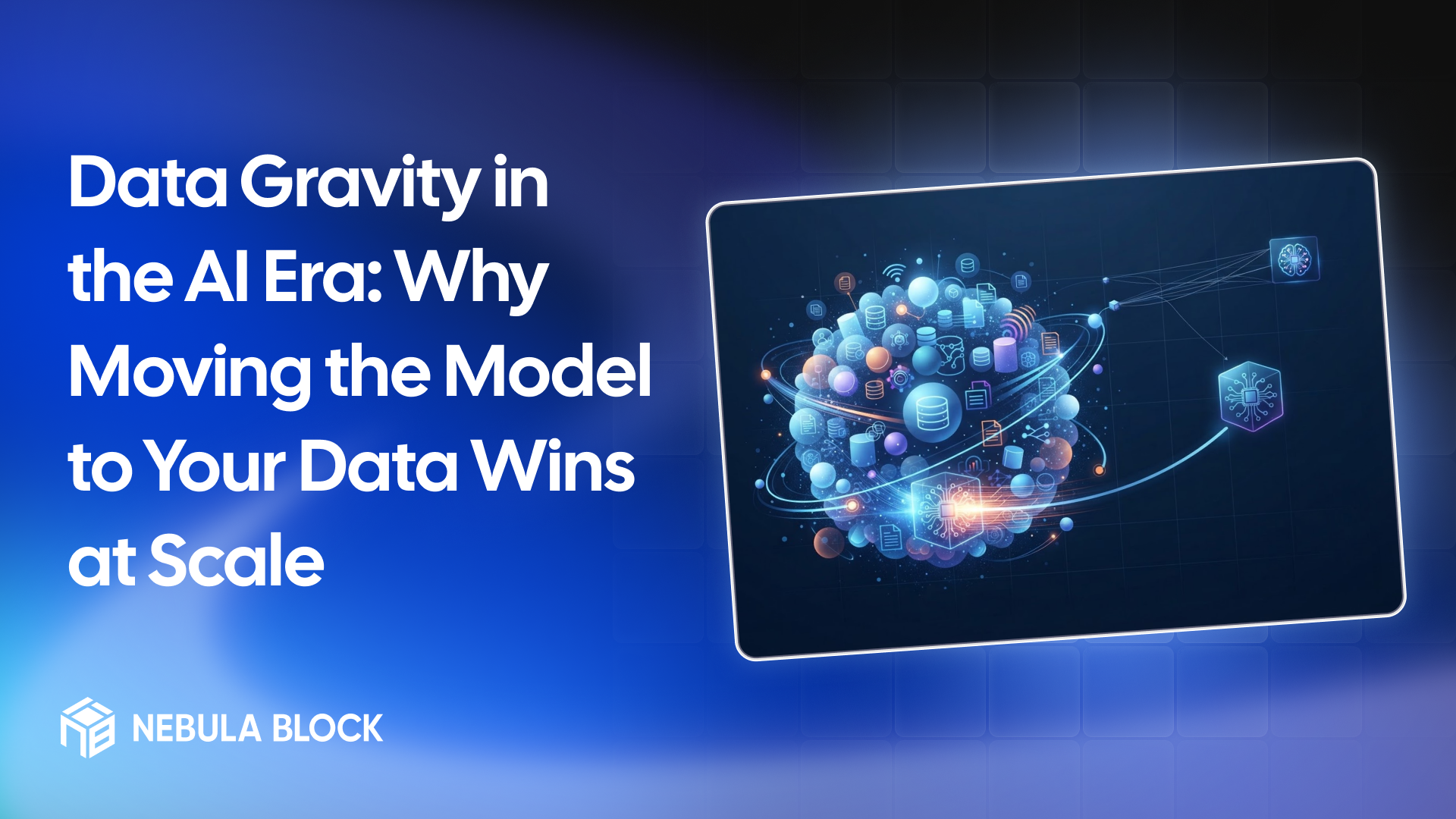
The default architecture for most AI adoption looks the same: data lives where it's always lived, and every AI workload ships a copy of the relevant slice of it out to wherever the model happens to run. This works fine at small scale. It becomes the dominant cost and risk driver in the architecture once data volume crosses a threshold — the same threshold where the old infrastructure principle of data gravity reasserts itself for AI the way it did for every previous generation of compute.
What Data Gravity Actually Means
Data gravity is a simple observation with large consequences: as a dataset grows, it becomes progressively more expensive and impractical to move, and progressively more sensible to bring the applications and processing to the data instead. A small dataset moves anywhere cheaply. A dataset measured in tens or hundreds of terabytes — the kind most enterprises actually have sitting in data lakes, warehouses, and document stores — has enough mass that moving it repeatedly for every workload that needs it becomes the dominant cost, not an incidental one.
This principle has already played out once in enterprise computing history, when analytics workloads shifted from "extract data to a specialized analytics environment" toward "run analytics where the data already sits." AI inference is now hitting the same inflection point, for the same underlying reason: the data got too large and too sensitive to keep shipping around.
Why AI Workloads Make This Worse, Not Better
Traditional data movement problems were mostly about bandwidth and time. AI inference adds two additional dimensions that make data gravity bite harder.
Egress and duplication costs compound with iteration. A single query against a remote dataset moves data once. An AI workload that needs to repeatedly retrieve, re-embed, and re-process the same underlying content — the normal pattern for retrieval-augmented generation, agent workflows, and any system with a real memory layer — moves it, or a derivative of it, over and over. Egress fees and duplicate storage costs that looked negligible for one query become a real, recurring line item at the volume and frequency AI workloads actually operate at.
Data sensitivity makes movement a risk decision, not just a cost decision. The same terabytes of enterprise data that are expensive to move are frequently the data an organization is least willing to move — customer records, proprietary documents, regulated data subject to the same cross-border and residency requirements we've covered elsewhere. Every copy created to feed a remote model is another copy that has to be secured, tracked, and eventually deleted — another surface for something to go wrong.
Freshness decays with every hop. Data copied out to feed a model is a snapshot, immediately starting to go stale relative to the source of truth. Workloads that need current information either accept staleness or rebuild the pipeline to re-sync constantly — and every re-sync is another data movement event, compounding the first two problems.
The Alternative: Move the Model, Not the Data
The architectural response to data gravity is to invert the default: rather than extracting data to wherever a model happens to run, deploy inference capability into the environment where the data already lives — the same data center, the same VPC, the same regulatory boundary — so the model does the traveling instead of the data.
This is the same reasoning that underlies the case for self-hosted and sovereign AI infrastructure in regulated industries, but it's a broader argument than compliance alone — it holds purely on cost and performance grounds too. Inference running next to the data it operates on avoids repeated egress costs, avoids the staleness that comes from working off a copy, and avoids creating additional copies of sensitive data that need their own security posture.
What This Requires in Practice
Bringing the model to the data isn't simply a matter of installing inference software somewhere new — it requires the same tiered pipeline thinking covered in optimizing data pipelines for sub-second agent latency: fast access to the data the model actually needs for a given task, without needing to relocate the entire dataset just to serve one workload. Practically, this means:
Inference infrastructure that can be deployed close to the data, whether that's on-premise, in the same cloud region and network boundary as the data's system of record, or on infrastructure specifically positioned to sit adjacent to a customer's existing data estate rather than requiring it to be exported first.
Data access patterns designed for local retrieval, using the same tiered caching and indexing approach that makes any retrieval-augmented system fast, but applied within the data's home environment rather than after shipping a copy elsewhere.
A deployment model that treats "where does this run" as a first-class architecture decision, evaluated per workload against where the relevant data actually sits, rather than defaulting every workload to whatever central inference endpoint already exists regardless of the data-gravity cost that default imposes.
When Centralized Inference Still Makes Sense
Data gravity is a strong default, not an absolute rule. Small datasets, public or already-shareable data, and workloads where the data volume genuinely is small relative to the value of centralizing model management can reasonably still ship data to a central inference point — the cost and risk calculus that favors local inference scales with data volume and sensitivity, and doesn't apply uniformly to every workload an organization runs.
Conclusion
Data gravity was true for analytics and it's proving true for AI, for the same underlying reason: past a certain scale, moving large or sensitive datasets repeatedly is more expensive and riskier than moving the much smaller, much more portable thing — the model — to wherever the data already sits. Organizations building AI infrastructure around the assumption that data will always travel to the model are building against a cost and risk curve that gets steeper every year their data grows, and the earlier that assumption gets revisited, the less expensive it is to fix.
Curious what deploying inference closer to your existing data estate would actually look like? Book a call with our team or explore the documentation to get started.
Learn more at
- Email: contact@nebulablock.com
- Website: nebulablock.com
- Docs: docs.nebulablock.com
- Book a call: nebulablock.com/contact