Agentic Architecture: Selecting the Most Cost-Effective Models for Multi-Agent Workflows
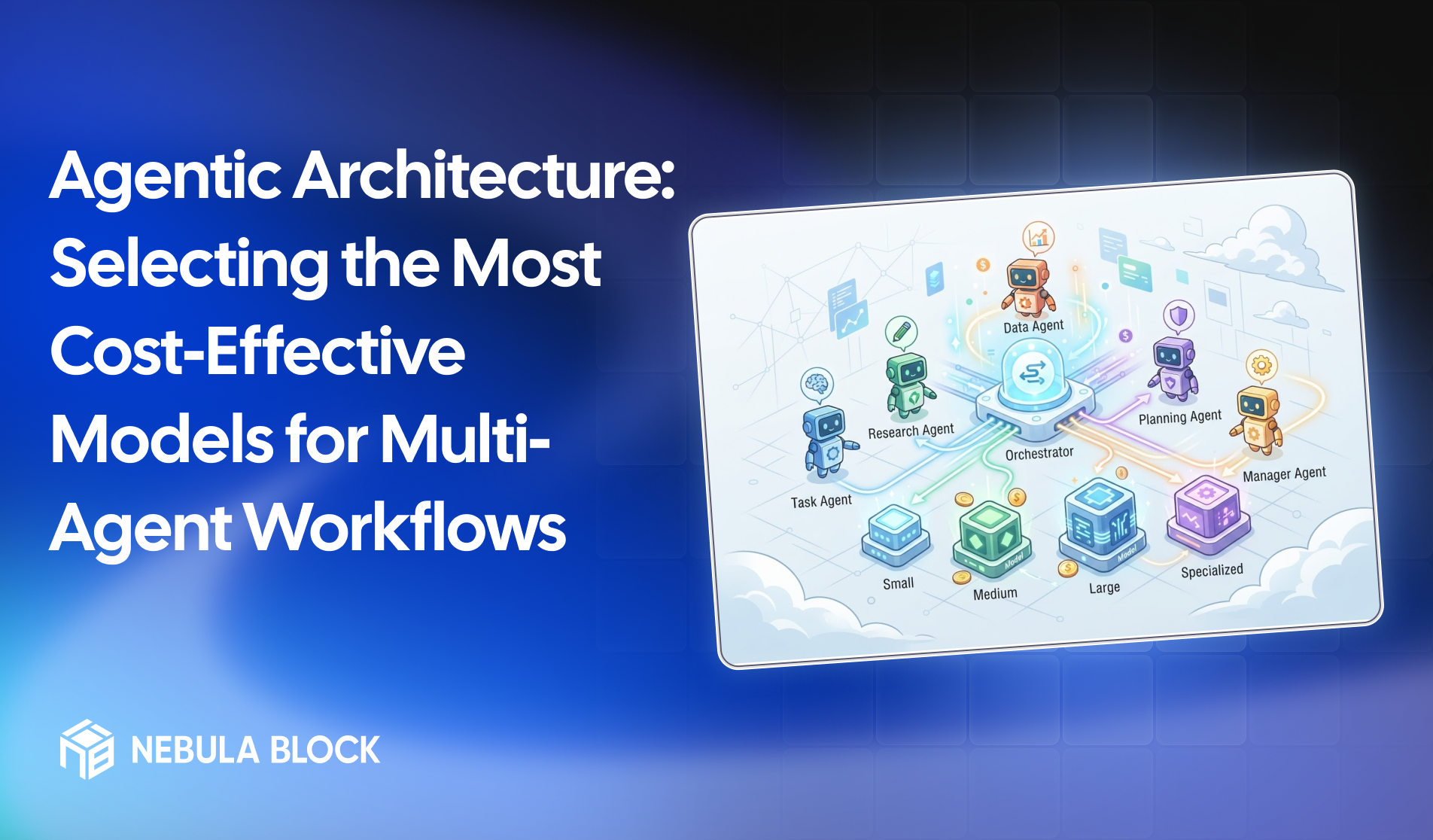
Quick answer: The most cost-effective multi-agent architecture assigns a different model to each role. A small model routes requests, a strong reasoning model plans, efficient specialist models do the bulk of the work, and a small verifier checks results before anything ships. Expensive reasoning is used only where decisions are hard.
What is a multi-agent workflow?
A multi-agent workflow splits a job across several specialized AI agents instead of one general agent. Each agent has a narrow role, its own tools and its own model. A claims-processing workflow, for example, might use one agent to read documents, one to check policy rules, one to draft a decision and one to verify it.
Specialization improves reliability, and it opens the biggest cost lever in agentic systems: you no longer need one expensive model for everything.
What does a cost-effective multi-agent architecture look like?
The pattern below is the most common cost-efficient layout: router, orchestrator, workers and verifier, with escalation to a person.
Only two of the six agents use a large reasoning model; small and efficient models handle routing, extraction, drafting and verification.
Which model should each agent use?
Open-weight MoE models fit the worker tier well because only a fraction of their parameters is active per token. A key release in the second half of 2026 for production coding and agentic workloads is DeepSeek-V4.1-Flash. DeepSeek describes it as a 552B-parameter Mixture-of-Experts model featuring a new Causal Encoder-Decoder architecture, activating roughly 8B parameters during input processing and 16B during output generation.
What drives cost in multi-agent workflows?
- Agent chatter. Agents passing full conversation transcripts to each other multiply input tokens at every handoff.
- Planning loops. An orchestrator that re-plans after every step burns its most expensive tokens.
- Unbounded retries. A worker that keeps retrying a failing tool call adds cost with no result.
- Duplicate context. Every agent re-reading the same policy document at full price.
How do you reduce multi-agent inference cost?
- Use structured handoffs. Pass compact JSON summaries between agents, not full transcripts.
- Cache shared context. Keep policies, tool definitions and system prompts in a cached prefix.
- Plan once, execute many. Let the orchestrator produce a plan; workers execute without consulting it each step.
- Set budgets per agent. Step limits, token caps and timeouts stop runaway loops.
- Run independent workers in parallel. It cuts latency without adding cost.
- Scale GPU capacity elastically. Self-hosted worker models should scale with queue depth, not sit idle at peak size.
When should you not use a multi-agent architecture?
If a single agent with a few tools can complete the task reliably, keep it simple. Every extra agent adds handoffs, latency and failure points. Split into multiple agents when roles need different tools, different permissions or different model tiers, or when one prompt grows too large to stay reliable.
For how model choices roll up into total cost, see The 2026 Guide to AI Agent Economics.
Deploy multi-agent workflows on Nebula Block, with open-weight models running on Canadian sovereign infrastructure.
Learn more at
- Email: contact@nebulablock.com
- Website: nebulablock.com
- Docs: docs.nebulablock.com
- Book a call: nebulablock.com/contact