The 2026 Guide to AI Agent Economics: Model Selection, Token Cost, and Efficiency
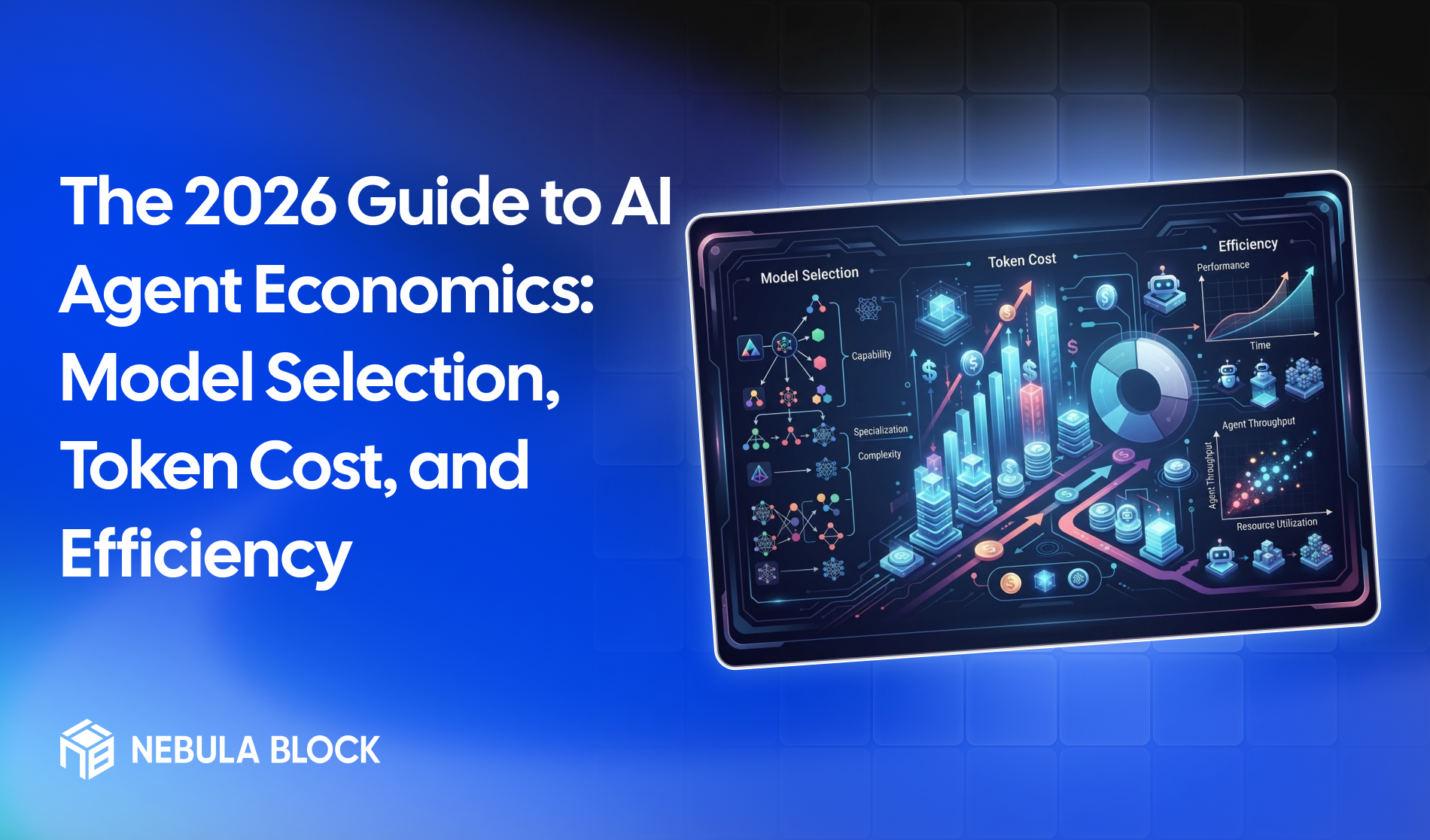
Quick answer: AI agent economics comes down to cost per completed task: tokens per step times steps per task times price per token, plus infrastructure, retries and human review. The biggest levers are choosing the right model per step, controlling how context grows across steps, caching repeated input, and deciding when self-hosting beats paying per token.
What are the unit economics of an AI agent?
An agent's cost per task can be broken into parts:
Token cost per step = (Input tokens × Input price per token) + (Output tokens × Output price per token)
Cost per task = Total token cost across all steps × (1 + Retry rate) + Infrastructure cost + Human review cost
Here, the total token cost is the sum of input and output token costs across all steps. The retry rate accounts for additional attempts, while infrastructure and human review costs are added separately.
What drives token cost in AI agents?
- Context growth. Each step usually re-sends the conversation so far, so input tokens grow with every step. A 30-step task can cost far more than 30 times a single call.
- Output and reasoning tokens. Output tokens are typically priced several times higher than input, and reasoning models generate extra thinking tokens.
- Tool results. Large API responses and documents pasted into context add up quickly.
- Retries and loops. Failed tool calls and re-planning repeat whole steps.
How does model selection change agent economics?
Model choice sets the price per token and the number of steps. A strong model may finish in fewer steps with fewer retries; a weak one may loop. That is why the right comparison is cost per completed task, not price per token.
When is self-hosting cheaper than paying per token?
Self-hosting can win when your GPUs stay busy. Its effective cost per token can be estimated as:
Self-hosted cost per token = GPU cost per hour ÷ (Tokens processed per GPU per hour at full load × Average GPU utilization)
Self-hosting is cheaper when its effective cost per token is below the API price per token. Low GPU utilization makes self-hosting more expensive, while elastic GPU capacity can help reduce idle costs.
What are the most effective efficiency levers?
- Route by difficulty. Match each step to the cheapest model that passes your quality bar.
- Compress context. Summarize earlier steps and pass structured state instead of full transcripts.
- Cache stable prefixes. System prompts, tool definitions and policy documents should be cached.
- Trim tool outputs. Return only the fields the agent needs from each API call.
- Cap reasoning and steps. Set thinking budgets, step limits and timeouts per task.
- Batch non-urgent work. Run backfills and reports asynchronously when capacity is cheapest.
- Scale GPUs elastically. Keep utilization high and avoid paying for idle capacity.
Which metrics should you track?
For turning these metrics into a business case, see The True ROI of AI Agents.
Nebula Block helps teams run agents on Canadian sovereign infrastructure. Talk to us about modeling your cost per task.
FAQ
- Why are AI agents more expensive than chatbots? Agents run many steps per task and re-send growing context at each step, so a single task uses far more tokens than one chat reply.
- What is the biggest driver of AI agent token cost? Usually context growth across steps, followed by output and reasoning tokens and large tool results.
- When should I self-host an LLM instead of using an API? When volume is high and steady enough to keep GPUs well utilized, or when data residency and privacy rules require keeping data in your environment.
- How do I calculate cost per task for an AI agent? Add token cost across all steps, multiply by one plus the retry rate, then add infrastructure and human review cost per task.
- What is the fastest way to improve agent efficiency? Compress context between steps, cache stable prompts and route simple steps to smaller models.
Learn more at
- Email: contact@nebulablock.com
- Website: nebulablock.com
- Docs: docs.nebulablock.com
- Book a call: nebulablock.com/contact