What Is Sovereign AI Infrastructure and Why Are Canadian Organizations Choosing It?
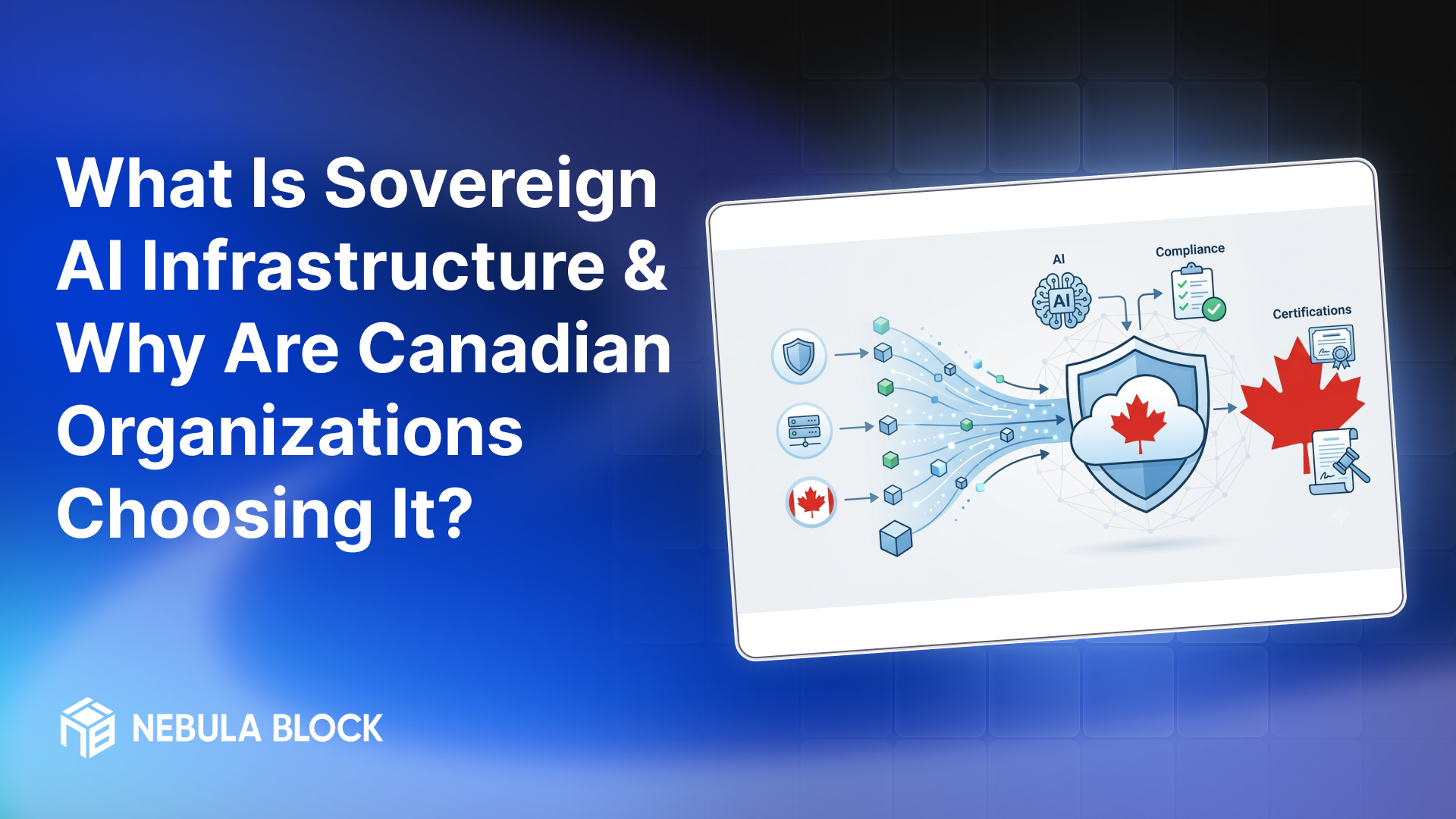
Sovereign AI infrastructure is AI compute, storage, and orchestration that operates entirely within one country's legal jurisdiction — owned, staffed, and governed by entities based in that country, so no foreign law can compel access to the data regardless of where it physically sits.
Canadian organizations are choosing it because data residency alone hasn't been enough: a data center located in Canada can still be legally compelled to hand over data under a foreign law like the U.S. CLOUD Act if its parent company is headquartered elsewhere, and Quebec's privacy regulator has visibly shifted from education to enforcement on exactly this gap.
Residency is not sovereignty
The distinction that matters is jurisdiction, not geography. A hyperscaler can open a data center in Toronto or Montreal and still be a U.S. company subject to U.S. law — meaning Canadian data stored on Canadian soil can, in specific circumstances, be reachable by a foreign government request the Canadian customer never consented to and may never even learn about.
Sovereign infrastructure closes that gap structurally: the operating company, the ownership, the staff with access, and the legal jurisdiction governing the infrastructure are all Canadian, so there's no foreign-operated entity in the chain for a foreign order to reach.
The regulatory pressure is real and immediate
Quebec's Law 25 (Bill 25) carries penalties of up to 4% of worldwide revenue or CAD $25 million, whichever is greater, and the Commission d'accès à l'information has moved from an education posture to active enforcement. For any organization handling Quebec residents' data, that's not a theoretical compliance exercise anymore — it's an active audit risk.
Sovereign infrastructure simplifies the underlying privacy impact assessment considerably, because there's no cross-border transfer to assess in the first place.
Security by design, not security by policy
The practical difference shows up in how protection is enforced. Security by policy relies on contracts and governance documents describing how data is supposed to flow. Security by design makes the wrong pathway structurally impossible — data can't cross a border it has no foreign endpoint to cross to.
On a sovereign stack, that plays out end to end: ingestion and preprocessing, vector stores and RAG pipelines, LLM inference, and agentic orchestration with policy guardrails all run inside the same jurisdictional boundary, with audit logs retained there too.
Performance no longer requires the trade-off
The historical objection to sovereign infrastructure was performance: smaller providers couldn't match hyperscaler hardware, so compliance meant accepting a slower stack. That trade-off is closing.
Nebula Block, Canada's sovereign AI cloud, runs infrastructure spanning NVIDIA A100, L40S, H100, H200, and B200 GPUs, extending to the GB300 NVL72 platform, which delivers roughly 30x the inference throughput of a comparable H100 configuration in a single rack. Organizations no longer have to choose between staying inside Canadian jurisdiction and getting frontier-class GPU performance.
What "choosing it" looks like in practice
Nebula Block is 100% Canadian incorporated, owned, and operated, with Canadian personnel and security clearances for anyone touching customer data, and holds SOC 2 and ISO 27001 certification aligned to PIPEDA and Bill 25 by default.
For Canadian financial services, insurance, legal, and healthcare organizations, that's the concrete shape sovereignty takes: not a marketing label, but an operating company, a jurisdiction, and an audit trail that all stay inside Canada's borders — with no need to trade away GPU performance to get there.
Learn more at
- Email: contact@nebulablock.com
- Website: nebulablock.com
- Docs: docs.nebulablock.com
- Book a call: nebulablock.com/contact