Building an AI Research Agent That Actually Synthesizes (Not Just Summarizes)
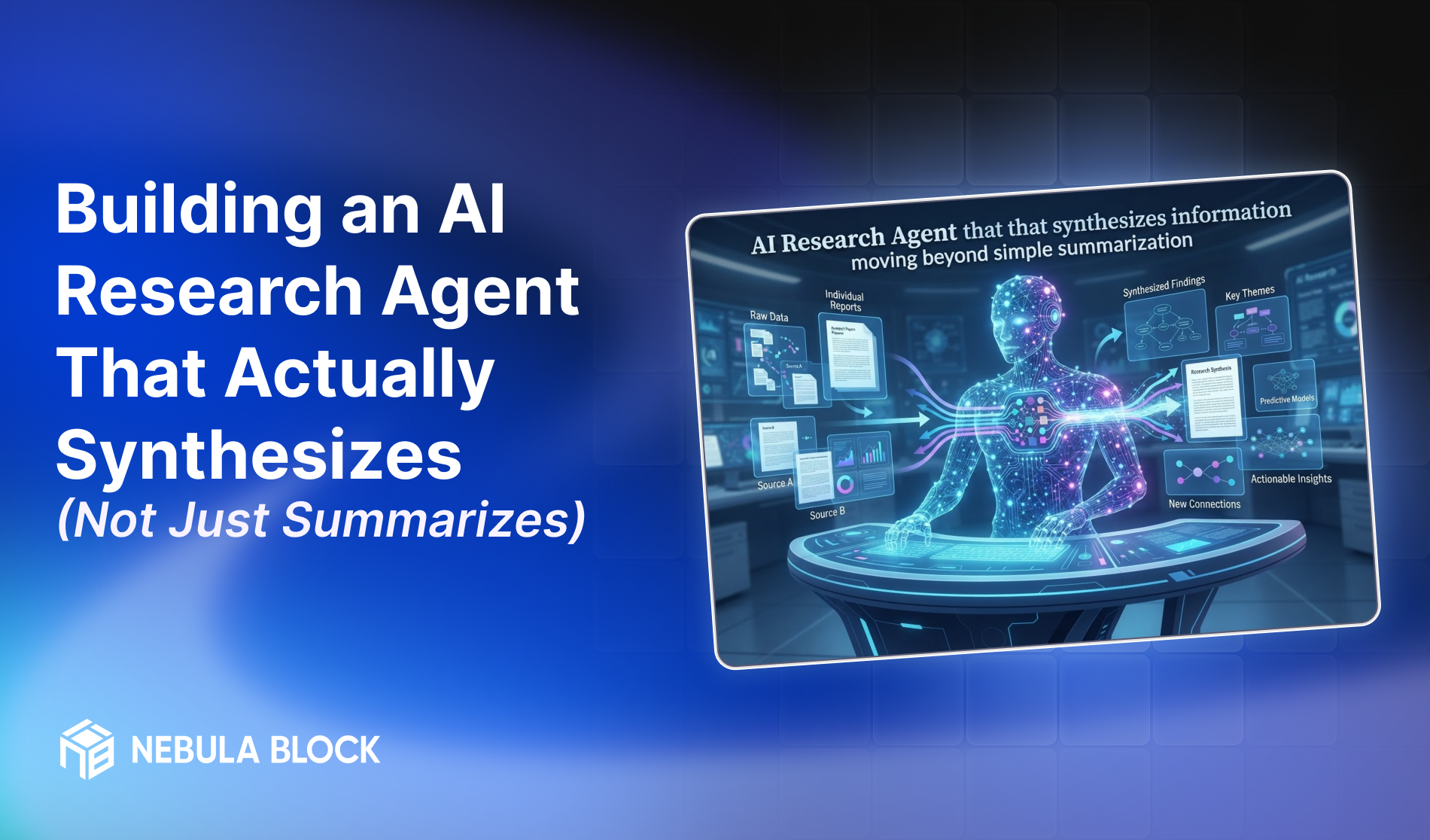
AI research agents are getting very good at finding information. They can search dozens of websites, extract passages, summarize papers, compare documents, and generate polished reports in minutes.
But finding and summarizing information is not the same as doing research.
A system that summarizes ten sources may simply be compressing ten independent documents into one response. Real research requires connecting evidence, detecting contradictions, evaluating source quality, identifying gaps, and producing conclusions that cannot be found in any single source.
1. Summarization vs. Synthesis
A conventional workflow looks like:
Search → Retrieve → Summarize → Combine → Answer
The problem is that each source remains an independent unit.
Synthesis works differently:
Evidence → Relationships → Hypotheses → Conclusion
For example, one source may show increasing inference demand, another variable GPU utilization, and another growing use of dynamic pricing.
The valuable insight comes from connecting these facts—not simply repeating them.
That is synthesis.
2. Start With Question Decomposition
Research questions are often too broad.
Instead of asking:
“Is decentralized inference economically viable?”
break the question into areas such as:
- Market demand
- Infrastructure costs
- Utilization
- Pricing
- User behavior
- Network design
This creates a research plan and makes missing evidence easier to identify.
3. Search for Evidence, Not Answers
A strong research agent should avoid searches that assume the conclusion.
Instead of:
“Why is decentralized inference cheaper?”
search for evidence around:
- GPU utilization
- Inference costs
- Provider pricing
- Infrastructure economics
- Counterexamples
The agent should deliberately look for supporting and opposing evidence.
The key question is not:
“What sources agree with my hypothesis?”
but:
“What evidence could change my hypothesis?”
4. Think in Claims, Not Documents
Instead of treating entire documents as the primary research unit, extract atomic claims.
For example:
“Dynamic batching increased GPU utilization from 35% to 72%.”
A claim like this can be compared, verified, connected to other claims, and assigned a confidence level.
Over time, these claims form a claim graph where the agent can identify relationships, conflicts, and emerging hypotheses.
5. Contradictions Are Valuable
Conflicting sources shouldn't simply be discarded.
If one source says decentralized inference reduces costs while another says it introduces coordination overhead, the agent should investigate:
- Are they measuring the same cost?
- Are they operating at the same scale?
- Are they using different hardware?
- What assumptions explain the difference?
Contradictions can reveal boundary conditions and lead to more nuanced conclusions.
6. Use the LLM Where Reasoning Matters
Not every research task requires a large language model.
Deterministic code can handle:
- Deduplication
- Metadata filtering
- Citation validation
- Source ranking
- Claim storage
LLMs should focus on higher-value tasks such as:
- Hypothesis generation
- Contradiction analysis
- Cross-source synthesis
- Uncertainty analysis
- Final argument construction
This can improve both cost and efficiency.
7. Research Should Be Iterative
A good research agent shouldn't simply:
Search → Summarize → Answer
It should work more like:
Question → Hypothesis → Search → Evidence → Challenge → Revise → Search Again → Synthesize → Verify → Conclude
The research process should change as new evidence appears.
8. What Good Research Looks Like
A strong AI research agent should be able to answer:
- What do we know?
- How do we know it?
- Which sources disagree?
- What evidence is missing?
- What assumptions are we making?
- Which conclusion is best supported?
- How confident should we be?
Most importantly:
What did we learn by combining these sources that we couldn't learn from any one of them individually?
That is the real test of synthesis.
Final Takeaway
The future of AI research isn't about generating better summaries.
It's about reasoning across information.
A good research agent should transform fragmented evidence into a defensible conclusion—using claims instead of documents, relationships instead of similarity, and hypotheses instead of summaries.
The goal isn't to summarize more information.
It's to understand what the information means together.
Learn more at
- Email: contact@nebulablock.com
- Website: nebulablock.com
- Docs: docs.nebulablock.com
- Book a call: nebulablock.com/contact