What Is Private AI Infrastructure and How Does It Secure Sensitive Data?
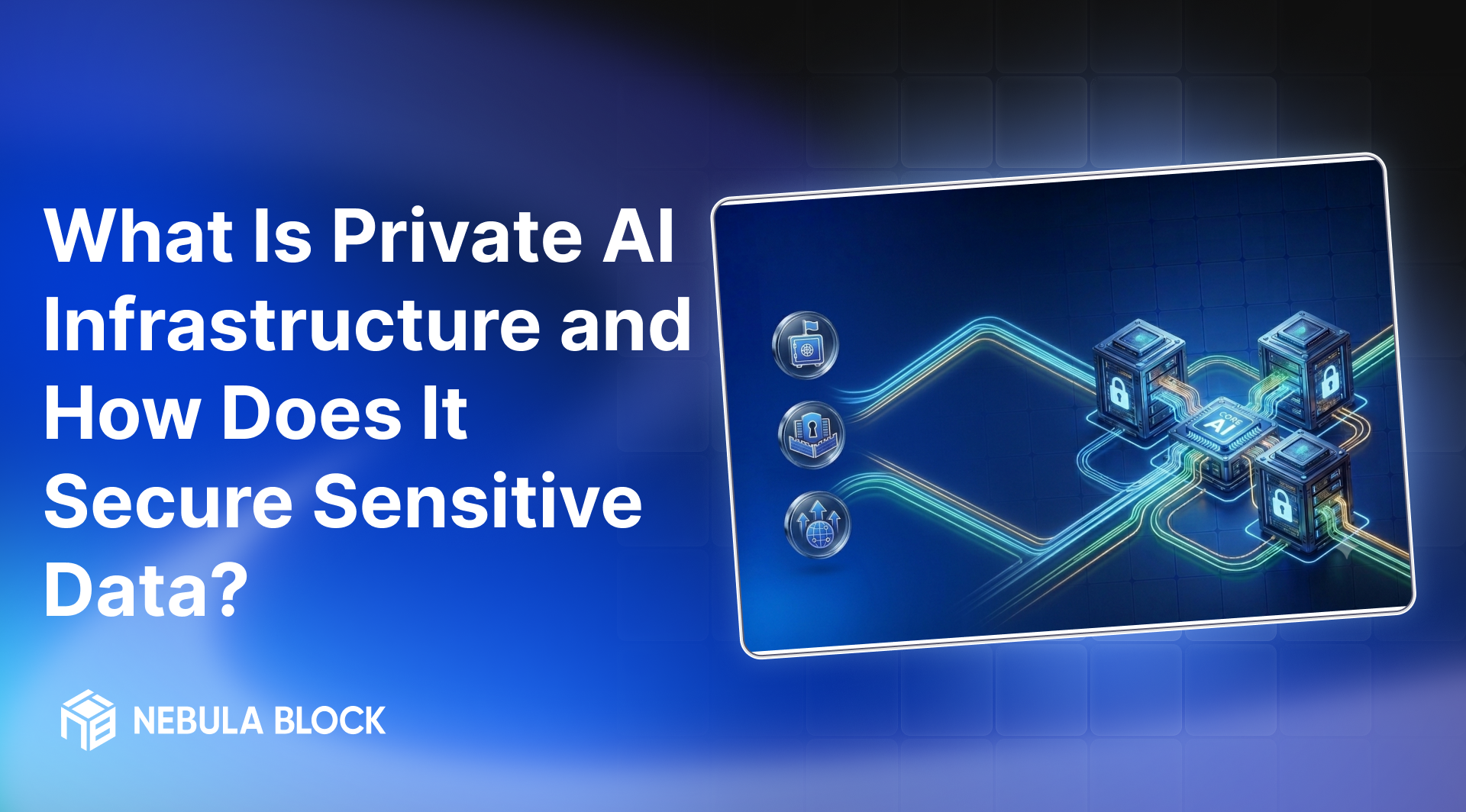
Private AI infrastructure means running models, training data, and inference compute inside an environment an organization controls directly, rather than on shared infrastructure operated by a third party for the general public. It secures sensitive data by architecture rather than by promise: data never crosses the boundary of a controlled perimeter, GPU capacity is dedicated rather than shared, and every prompt, retrieval, and response is logged on infrastructure the organization — not a vendor — controls.
The core difference from public AI services
Most consumer and general-purpose AI tools run on multi-tenant infrastructure, where your prompts and data pass through shared compute and, in many cases, may be used to improve the underlying model.
Private AI infrastructure inverts that: training data and model weights stay within an organizational or contractual boundary, deployed on-premises, in a private cloud, or on dedicated infrastructure with confidential-computing-grade isolation. The distinction isn't a checkbox — it changes who can technically access the data, not just who is contractually permitted to.
Data isolation and sovereignty
The central security benefit is that data never crosses the enterprise perimeter, which allows compliance with frameworks like HIPAA, GDPR, or PIPEDA to rest on how the system is built rather than on a vendor's contractual commitments. That distinction matters under audit: a regulator or auditor can verify an architectural boundary far more easily than they can verify an internal promise about how a third party handles your data once it leaves your control.
Model ownership and dedicated compute
When a model is fine-tuned on proprietary data, the resulting weights encode real institutional knowledge — pricing logic, internal processes, domain expertise. Private AI infrastructure keeps those weights as the organization's own asset rather than a resource that a shared vendor platform might reuse elsewhere.
Pairing that with dedicated, single-tenant GPU instances (bare metal or reserved, rather than shared multi-tenant capacity) closes off the noisy-neighbor and cross-tenant memory-contention risks that come with sharing physical hardware — a security property, not just a performance one.
Governance and auditability
Because everything runs on infrastructure the organization can fully instrument, every inference call produces a complete, timestamped record — which prompts hit which model, what was retrieved, what was returned — instead of a summary an external API happens to expose.
That level of logging is often the difference between passing and failing a compliance audit for regulated workloads in financial services, healthcare, and government.
Deployment models, from strongest control to most convenience
Organizations typically choose from three approaches: fully on-premises infrastructure, which offers the strongest control but the highest operational burden; a private cloud with dedicated, single-tenant hardware, which keeps most of the isolation benefit while removing the burden of running your own data center; or confidential computing inside a public cloud, using hardware-based enclaves for isolation on shared infrastructure. Most enterprises land on the middle option — dedicated infrastructure inside a private cloud — because it delivers architectural isolation without the capital cost of owning the data center.
What to actually check before calling something "private AI"
The label gets applied loosely, so the questions worth asking a provider are concrete:
- Is the GPU capacity dedicated (bare metal or reserved single-tenant) or shared?
- Is there a certified security posture — SOC 2 Type II, ISO 27001 — backing the architecture rather than just a policy document?
- Is the data processed and stored under a jurisdiction you actually control, with no default use of your data for model training?
Providers like Nebula Block build to that bar directly — dedicated GPU instances, SOC 2 and ISO 27001 certification, and a Canadian-jurisdiction data boundary — because for regulated data, the infrastructure has to make the wrong data flow structurally impossible, not just contractually discouraged.
Learn more at
- Email: contact@nebulablock.com
- Website: nebulablock.com
- Docs: docs.nebulablock.com
- Book a call: nebulablock.com/contact