The Cost of Complacency: The Imminent Legal Risks of Unvetted RAG Training Data
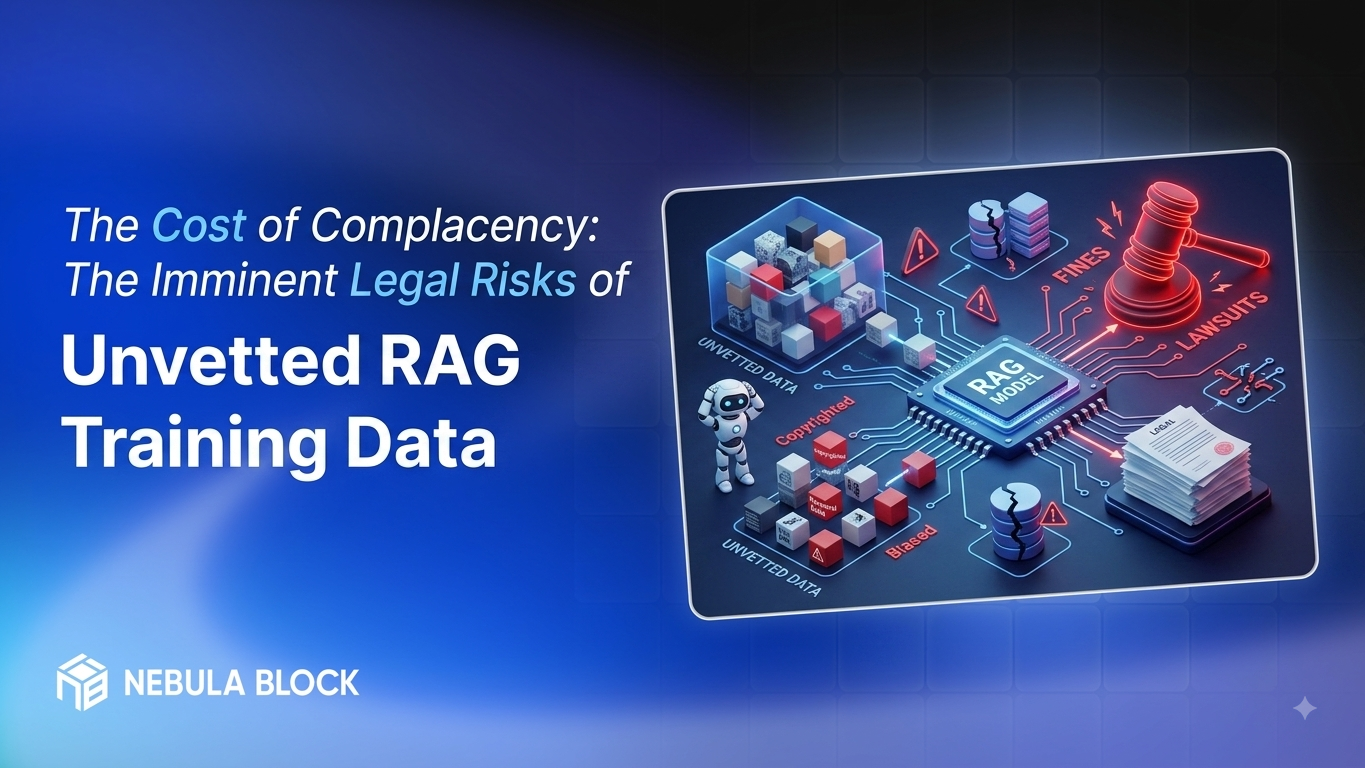
Retrieval-augmented generation solved a real problem. Instead of retraining a model every time your knowledge base changed, you could index your documents, retrieve the relevant chunks at query time, and let the model reason over fresh, grounded context. It's efficient, it's flexible, and it's now the default architecture for enterprise AI applications.
It's also become one of the least-governed pipelines in the modern enterprise stack — and that's a legal problem waiting to surface.
The blind spot: "It's just retrieval, not training"
A common assumption inside engineering teams is that RAG carries less legal exposure than fine-tuning, because the underlying model weights never change. The corpus lives in a vector store, not in the model itself, so the reasoning goes that whatever legal risk exists is somehow contained or deferred.
That distinction doesn't hold up under scrutiny.
When a RAG system retrieves a chunk of text and passes it into a prompt, the model can reproduce that text — sometimes verbatim — in its output. If that chunk came from a copyrighted document, a vendor's licensed dataset, a customer's confidential file, or a source containing personal information, the fact that it was "just retrieved" rather than "trained on" doesn't change what the system just did: it exposed protected content to an end user, potentially outside the terms under which that content was obtained.
Legally, retrieval-time exposure and training-time memorization are different mechanisms, but they can produce the same category of harm — unauthorized reproduction, unauthorized disclosure, or unauthorized use of data outside its licensed purpose.
Where the exposure actually comes from
Unvetted RAG corpora tend to accumulate risk from a handful of predictable sources:
Scraped or aggregated web content. Teams under deadline pressure often bootstrap a knowledge base by crawling public sites, forums, or documentation pages. Ownership, licensing terms, and usage restrictions on that content are rarely checked before ingestion.
Third-party and vendor data used outside its license scope. A dataset licensed for internal analytics is not automatically licensed for use as retrieval context in a customer-facing chatbot. License terms are often narrower than the way the data actually gets used once it's in a shared corpus.
Customer and employee documents containing PII or PHI. Support tickets, contracts, HR records, and internal wikis frequently get pulled into a RAG index for "search improvement" without going through the same data classification process that would apply if that data were moved into a traditional database.
Decentralized ingestion. In most organizations, more than one team can add documents to a shared knowledge base. Without a review gate, the corpus becomes an accumulation of whatever anyone thought might be useful — with no single owner accountable for what's actually in it.
Stale legal assumptions. Data that was compliant to store two years ago may not be compliant to retrieve and generate from today, especially as copyright litigation against AI companies and regulatory guidance on automated processing of personal data continue to evolve.
Why RAG makes this harder to catch than it looks
Training-time risk gets scrutinized because everyone understands, intuitively, that training on a document is a significant act — it usually triggers a review, or at least a raised eyebrow. RAG doesn't get the same scrutiny because adding a document to a retrieval index feels administrative, not consequential. It's the same button click as adding a file to a shared drive.
That's precisely what makes it dangerous. The barrier to ingestion is low, the corpus grows continuously, and the connection between "a document was added to the index six months ago" and "the model just generated a paragraph copied from that document" is invisible unless you're specifically looking for it.
There's also a discovery problem. Legal and compliance teams can audit a training dataset because it's usually a discrete, versioned artifact. A live vector store, updated by multiple teams on a rolling basis with no changelog, is much harder to reconstruct after the fact — which is exactly the scenario you don't want to be in when a regulator or plaintiff's counsel asks what your system had access to on a given date.
The compounding cost of waiting
The cost of vetting a RAG corpus scales roughly linearly with effort — the more documents, the more review needed. The cost of not vetting it scales very differently.
An ungoverned corpus that generates copyrighted output, discloses PII, or violates a data-use agreement doesn't just create a one-time incident. It creates:
- Retroactive audit burden. Once a problem surfaces, you have to reconstruct what was in the corpus, when, and how it was sourced — often without the metadata to do so cleanly.
- Remediation across every downstream system. If the same corpus feeds multiple applications, the fix isn't contained to one product.
- Discovery exposure in litigation. A retrieval log showing exactly what content was surfaced to which users, at what time, is discoverable — and if that log doesn't exist, its absence becomes its own problem.
- Regulatory and contractual consequences. Beyond copyright, unvetted corpora can trigger exposure under data protection law, sector-specific regulations, and the terms of vendor and customer contracts that were never written with generative retrieval in mind.
None of this is hypothetical risk in the abstract sense — it's the direct, foreseeable consequence of treating a retrieval corpus as a technical asset rather than a governed one.
What "vetted" actually looks like in practice
Fixing this isn't about slowing down RAG development. It's about adding a small number of structural controls that most engineering teams don't currently have:
Data provenance tracking. Every document entering a retrieval corpus should carry metadata about its source, license terms, and classification — before it's indexed, not after something goes wrong.
License and rights classification at ingestion. A lightweight gate that requires an answer to "what are we allowed to do with this document" before it enters a shared index, rather than assuming the answer is "anything."
PII and sensitive-data scanning. Automated scanning for personal or sensitive information at the point of ingestion, with a defined policy for redaction, exclusion, or restricted-access indexing rather than blanket inclusion.
Retrieval-time guardrails. Filtering or flagging retrieved chunks that fall into high-risk categories before they're passed into a generation prompt, rather than relying entirely on ingestion-time controls.
Corpus ownership and review cadence. A named owner for each retrieval corpus, with a periodic review process — because a corpus that was clean at launch will not stay clean as ingestion continues.
Audit logging. A record of what was retrieved, from which source document, in response to which query, so that if a question arises later, the answer doesn't depend on institutional memory.
The takeaway
RAG made it easy to keep AI systems current without retraining. It also made it easy to build a retrieval corpus with the same discipline as a shared drive — which is to say, very little. The organizations that treat their retrieval corpora with the same governance rigor as any other regulated data asset will avoid a category of legal risk that is currently accumulating, quietly, in production systems that no one has audited yet.
Complacency here doesn't announce itself. It just waits for the moment your system generates the wrong paragraph to the wrong person, from a source no one remembers approving.
Learn more at
- Email: contact@nebulablock.com
- Website: nebulablock.com
- Docs: docs.nebulablock.com
- Book a call: nebulablock.com/contact