What 'Agentic AI' Really Means and What Infrastructure It Needs
We’ve officially hit peak hype. "Agentic AI" is the latest tech buzzword being slapped onto just about anything with an LLM attached to it.
Got a customer support chatbot with a slightly longer system prompt? Agentic. A Python script that calls an API twice? Agentic. A basic automation workflow with a single if/else conditional branch? You guessed it.
This marketing fluff isn’t just annoying; it’s dangerous. Building genuinely autonomous systems requires a technology stack that is categorically different from a standard LLM wrapper. When engineering teams treat them the same, they usually find out they messed up via a massive production incident or an eye-watering API bill.
If you are looking to move past the hype and actually build these systems, let's look at what "agentic" actually means, and break down the infrastructure required to run them safely.
What Is Agentic AI?
Let's cut through the noise with a practical working definition:
An agentic system is one where the model doesn't just generate text—it decides what to do next, uses tools to execute that decision, and iterates across multiple steps with little to no human intervention. Crucially, the exact sequence of actions is not hardcoded by the developer.
That last clause is the real dividing line.
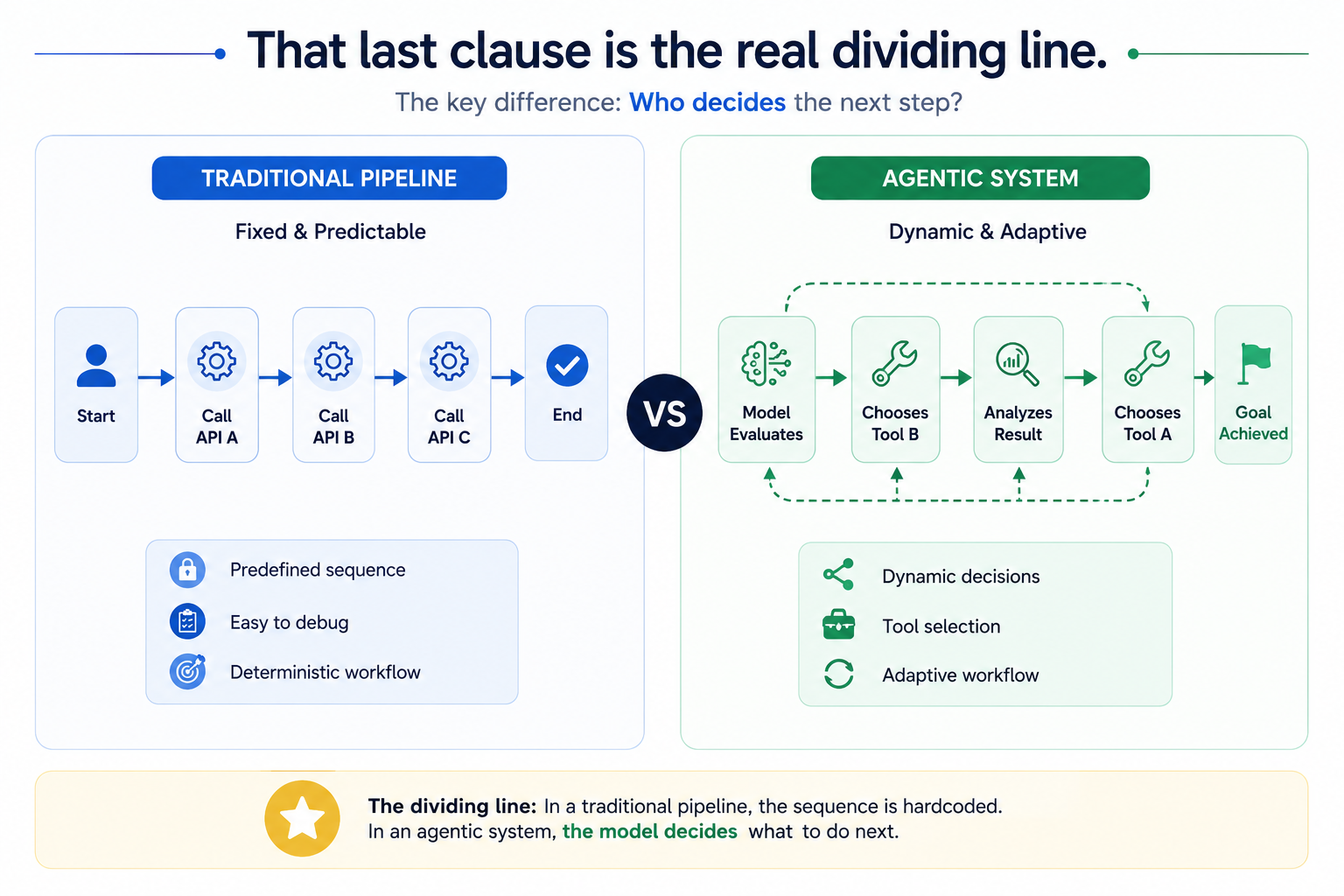
If your application always calls the same three APIs in the exact same order every single time, it is not an agent. It’s a traditional software pipeline with an LLM step in it. There is absolutely nothing wrong with that it’s predictable and highly effective but it doesn't require specialized agent infrastructure.
A system becomes agentic when the model itself chooses which tool to call, in what order, how many times, and when to stop. The moment you hand over that autonomy, complexity scales exponentially. You aren't just dealing with higher traffic volume; you are dealing with entirely new, chaotic ways for software to fail.
Agentic AI Infrastructure Stack
Building reliable Agentic AI systems requires more than model inference. Organizations need multiple infrastructure layers working together to maintain visibility, control, and security.
1. Agent Orchestration
Think of orchestration as air traffic control.
Individual agents may make local decisions, but orchestration manages:
- Task routing
- Agent coordination
- Workflow recovery
- Failure handling
- Policy enforcement
Without orchestration, organizations often end up with agent sprawl: dozens of autonomous workflows operating without centralized oversight.
For enterprise deployments, orchestration becomes the control plane for the entire agent ecosystem.
2. Memory and State Management
Effective AI agents need both short-term and long-term memory.
- Short-Term Memory
Maintains context during a single task or conversation.
- Long-Term Memory
Stores historical information across sessions, users, and workflows.
However, memory systems must do more than store embeddings.
They must determine:
- What information should be remembered
- What should be forgotten
- How memories are retrieved
- How state is restored after failures
Checkpointing is particularly important.
If an agent fails on step seven of a ten-step process, organizations should be able to resume from the previous checkpoint rather than repeating the entire workflow.
This becomes critical when earlier steps involve real-world actions such as:
- Database updates
- Financial transactions
- Infrastructure provisioning
- Customer account modifications
3. Tool Integration and API Management
Every tool increases an agent's capabilities.
Every tool also expands the attack surface.
Tool access should never be managed through scattered API keys or hardcoded credentials.
Production systems require:
- Centralized authentication
- Permission controls
- Rate limiting
- Audit logging
- Credential management
The industry is increasingly moving toward standardized integration approaches such as Model Context Protocol (MCP), which provides a common framework for connecting AI systems to tools and data sources.
As enterprises adopt more AI agents, interoperability becomes just as important as model quality.
4. Identity, Permissions, and Governance
One of the most overlooked challenges in Agentic AI architecture is identity management.
When an agent acts on behalf of a user:
- What permissions does it inherit?
- What actions can it perform?
- Can it delegate tasks?
- How are those permissions propagated?
Without proper governance, privilege escalation becomes a serious risk.
A customer support agent attempting to process a refund should never gain administrative access to infrastructure systems simply because permissions were inherited incorrectly.
Identity and access management must be designed into the platform from the beginning.
5. Observability and Tracing
Traditional application logging won't save you here. If an agent gives a bizarre, broken output, looking at the final answer is useless. You have to trace the reasoning path.
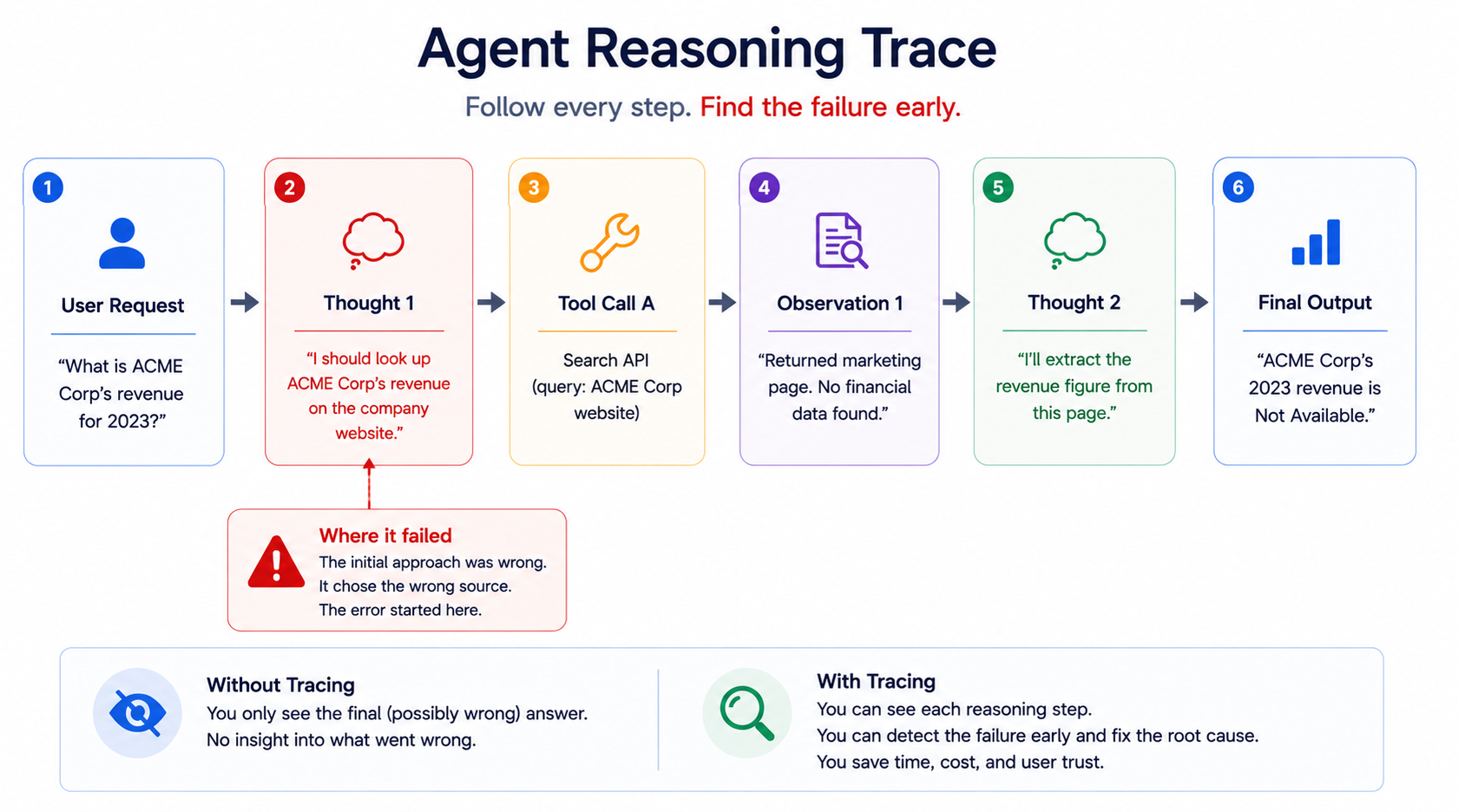
Every loop, tool call, and internal monologue step needs structured logs and correlation IDs. Most early agent failures don't happen because the LLM is inherently "dumb"; they happen because developers have zero visibility into the intermediate steps where the logic went off the rails.
6. Sandboxing and Execution Environments
If an agent can write and run code, browse the web, or manipulate local files, it must live in an isolated, ephemeral container. Period. Letting an autonomous agent execute LLM-generated code directly on a production server is an open invitation for a catastrophic security breach.
7. Cost and Resource Controls
Standard apps don't accidentally spend $5,000 in an hour. Agentic apps can. If an agent gets stuck in an infinite planning loop, or keeps retrying a broken tool because the output wasn't what it expected, it will burn through your API limits instantly. You need hard-coded circuit breakers built into the infrastructure: max step counts, strict time budgets, and dollar-amount caps. Never trust the model to police its own budget.
Architectural Patterns: Supervisor vs. Peer-to-Peer
When you move beyond a single agent, you have to choose how they coordinate with one another. There are two primary shapes, and both come with trade-offs.
How to Build Agentic AI Without Wasting Time and Money
One of the biggest mistakes organizations make is overengineering from the beginning.
You do not need:
- Multi-agent swarms
- Persistent global memory
- Complex peer-to-peer communication
- Autonomous decision networks
to automate a simple workflow.
A more practical approach is:
Start Small
Deploy a single agent with narrowly scoped responsibilities.
Invest Early in Observability
Build tracing and monitoring before scaling complexity.
Scale Based on Evidence
Only introduce advanced orchestration, memory, or multi-agent systems when production data demonstrates a clear need.
The most successful enterprise AI deployments are not the most autonomous. They are the most controllable.
The Future of Enterprise Agentic AI
The industry is gradually moving toward a model where AI agents are widely deployed but selectively trusted.
Organizations increasingly view agents as capable operators working inside heavily governed platforms rather than autonomous digital employees.
This shift reflects a broader reality:
Agentic AI is not a feature.
It is a behavioral change in how software operates.
The real engineering challenge is no longer:
"How do we make AI autonomous?"
The more important question is:
"Now that AI can make its own decisions, how do we observe, control, and reverse those decisions when necessary?"
Building production-grade Agentic AI requires far more than deploying an LLM. Organizations need orchestration, memory, governance, observability, and secure infrastructure to safely operate autonomous AI systems at scale.
Learn more at
- Email: contact@nebulablock.com
- Website: nebulablock.com
- Docs: docs.nebulablock.com
- Book a call: nebulablock.com/contact