Self-Hosting LLMs in Regulated Industries: Deployment Patterns for Finance and Healthcare
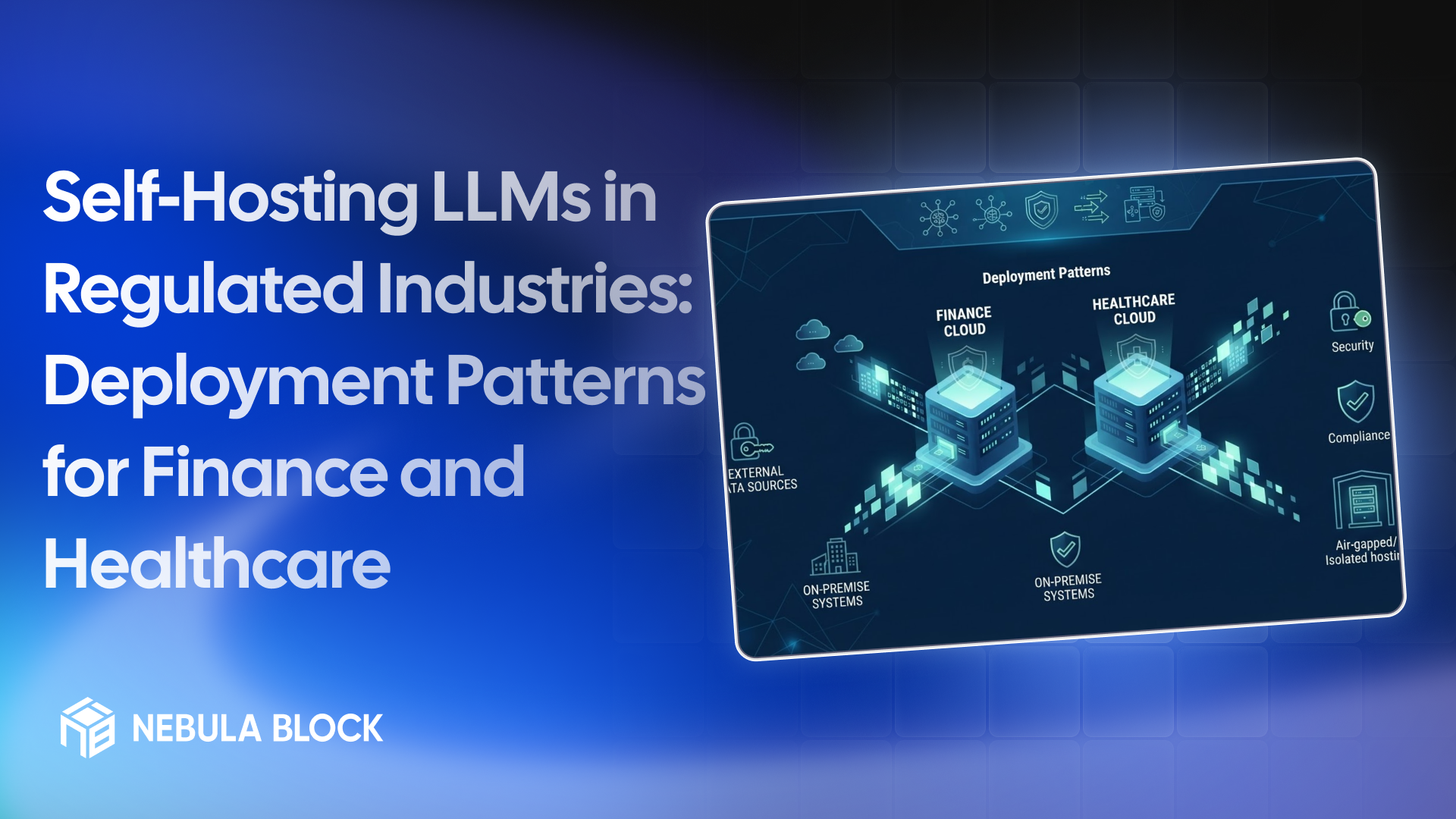
Self-hosting LLMs for regulated industries is not simply a question of where a model runs. It is a decision about data access, infrastructure control, security, and operational responsibility.
For organizations in financial services, healthcare, and other regulated sectors, using an external AI API may raise questions about where data travels, who can access it, how long it is retained, and whether model activity can be audited.
Running a model in your own environment can provide greater control over these factors. But self-hosting also means taking responsibility for infrastructure, security, model maintenance, and ongoing operations.
There is no single deployment model that works for every organization. The right choice depends on the sensitivity of the workload, existing infrastructure, internal capabilities, and governance requirements.
This guide compares three approaches: on-premises deployment, dedicated private cloud, and hybrid architecture.
What Does Self-Hosting an LLM Mean?
Self-hosting means running an open-weight or otherwise deployable large language model (LLM) in an environment controlled by your organization or its designated infrastructure provider.
Instead of sending prompts directly to a public AI service, your application sends requests to an inference endpoint running in your chosen environment.
That environment could be:
- On-premises infrastructure: GPUs and supporting systems located in your own data centre.
- Dedicated private cloud: Isolated compute resources hosted by a cloud infrastructure provider.
- Hybrid infrastructure: A combination of private inference and external services, managed through a policy gateway.
Self-hosting does not automatically make an AI deployment compliant or secure. You still need to control access, protect data, monitor model behaviour, and maintain appropriate governance processes.
The main benefit is greater control over the infrastructure and data flows involved in running your models.
When Should You Consider Self-Hosting?
Self-hosting becomes worth evaluating when an AI workload creates requirements that are difficult to satisfy through a standard third-party API.
Consider it when:
- Sensitive data enters model prompts. Customer records, financial information, patient data, or confidential business documents may require stricter access and retention controls.
- You need greater control over model versions. Your team may need to manage model updates, testing, and deployment schedules rather than depend entirely on a provider.
- Your organization has specific infrastructure requirements. These may include network isolation, dedicated compute, private connectivity, or defined data locations.
- You need more visibility into inference activity. Internal teams may require detailed records of model requests, access permissions, and system changes.
- Your workload is large or predictable enough to justify dedicated infrastructure. Consistent inference demand may make a self-hosted deployment worth evaluating financially.
However, self-hosting is not always the best option. For less sensitive workloads, a managed API may offer a simpler operating model with fewer infrastructure responsibilities.
Comparing Three LLM Deployment Patterns
The three common deployment patterns differ mainly in infrastructure ownership, isolation, and operational responsibility.
| Deployment pattern | Infrastructure | Best suited for | Main consideration |
|---|---|---|---|
| On-premises | Organization-owned data centre | Strict infrastructure and network control | Requires internal infrastructure operations |
| Dedicated private cloud | Isolated resources from a cloud provider | Teams needing dedicated compute without operating their own data centre | Requires provider and access-control due diligence |
| Hybrid with policy gateway | Private and external inference endpoints | Organizations with different data sensitivity levels across workloads | Requires consistent routing and governance |
Pattern 1: Air-Gapped or On-Premises Deployment
An on-premises deployment runs inference on infrastructure located in an organization's own data centre. In more restrictive environments, the deployment can also use network isolation or an air-gapped architecture.
A typical setup includes:
- GPU servers hosting the model inference runtime.
- Internal APIs connecting business applications to the inference service.
- Identity and access management for users and services.
- Internal storage for model files, logs, and supporting data.
- Monitoring and security systems operated by the organization.
This pattern is relevant when an organization needs direct control over its infrastructure and network boundaries.
Before choosing it, check whether your team can operate the full stack, including GPU provisioning, hardware maintenance, model serving, security updates, monitoring, and incident response.
Pattern 2: Dedicated Private Cloud
A dedicated private cloud provides isolated compute resources through an infrastructure provider. Your organization runs its LLM workloads on those resources without having to own and maintain an entire data centre.
A typical architecture includes:
- Dedicated GPU instances or bare-metal servers.
- Private networking between applications and inference endpoints.
- Access controls for administrators, developers, and services.
- Storage and backup configurations defined for the deployment.
- Monitoring and operational responsibilities shared between your team and the provider.
This approach can suit teams that need dedicated GPU capacity but do not want to manage physical data-centre infrastructure themselves.
When comparing private cloud options, look beyond the hourly GPU rate. Bare-metal and virtual-machine deployments can differ in resource allocation, performance, isolation, and operational flexibility. See our guide to Bare-Metal vs Cloud GPU Instances: Which Is More Cost-Effective on Nebula Block?.
Also review the provider's data-handling practices. Check where logs and backups land, who can access the infrastructure, how support access works, and which geographic locations are involved.
Pattern 3: Hybrid Deployment with a Policy Gateway
A hybrid architecture routes requests to different inference environments based on workload requirements.
For example, an organization might process sensitive internal documents through a private LLM endpoint while using an external API for general-purpose tasks that do not involve restricted information.
A policy gateway sits between applications and model providers. It evaluates requests and determines which inference endpoint can handle each task.
A simplified architecture looks like this:
                 Business Applications
                          |
                          v
                 API / Policy Gateway
                          |
              Request and Policy Checks
                          |
              +-----------+-----------+
              |                       |
              v                       v
       Sensitive Workloads      General Workloads
              |                       |
              v                       v
       Private LLM Endpoint     External Model API
              |                       |
              +-----------+-----------+
                          |
                          v
                Logging and Monitoring
The gateway can enforce controls such as:
- Routing rules based on data classification.
- Authentication and authorization.
- Restrictions on which models can process specific requests.
- Request logging and usage monitoring.
- Approval requirements for selected workflows.
This pattern is useful when an organization has several AI use cases with different data sensitivity levels.
The key is to make routing decisions explicit and enforceable. Define which data can leave the private environment, which endpoints are approved, and what happens when a request does not meet policy requirements.
GPU Infrastructure and the Cost of Self-Hosting
Running an LLM privately requires more than selecting a model and renting a GPU.
The infrastructure must support the model's memory requirements, expected request volume, and performance targets. GPU selection therefore affects both deployment feasibility and operating cost.
One important factor is VRAM. Model weights, context length, batch size, and runtime overhead all influence how much GPU memory an inference workload needs.
A model that fits into available VRAM under light testing may require more resources when handling longer prompts or concurrent requests.
For a practical breakdown, see our guide: How Much GPU VRAM Do You Need to Run an LLM?.
When estimating the cost of a self-hosted deployment, account for:
- GPU capacity: The hardware needed to load the model and handle expected inference demand.
- Utilization: Whether dedicated GPUs remain productive or sit idle during periods of low demand.
- Storage and networking: Model files, datasets, backups, and traffic between applications and inference services.
- Operations: Infrastructure maintenance, monitoring, security updates, and incident response.
- Model lifecycle: Evaluation, version management, performance testing, and deployment changes.
Compare the full operating cost with the cost of using a managed inference API. A lower hourly GPU price does not necessarily mean a lower cost per successful task.
Industry-Specific Considerations
Different industries face different data-handling and governance requirements. The deployment architecture should reflect the actual workflows and risks involved.
Financial Services
- Protect sensitive information: Identify whether prompts contain customer records, transaction details, internal research, or other confidential information.
- Maintain model governance: Record model versions, evaluation results, configuration changes, and the intended use of each AI system.
- Review third-party dependencies: Assess infrastructure providers, external model services, access arrangements, and relevant vendor-risk requirements.
Healthcare
- Protect patient information: Review how prompts, uploaded documents, embeddings, cached summaries, and logs are stored and accessed.
- Define appropriate use cases: Separate administrative and documentation support from workflows that could influence clinical decisions.
- Maintain human oversight: Establish review procedures for AI-generated content, especially when outputs may affect patient care or clinical records.
Self-hosting can support these controls, but the deployment still needs appropriate privacy, security, and governance processes.
Five Essential Controls for a Self-Hosted LLM
A private inference endpoint is only one part of a secure AI environment. The surrounding systems determine who can use it, what information it processes, and how its activity is monitored.
Focus on five areas:
1. Identity and Access Management
Define who can access model endpoints, infrastructure, storage, and administrative tools.
Use role-based permissions, restrict privileged accounts, and review service credentials regularly. Avoid giving every application or developer unrestricted access to every model.
2. Encryption and Data Handling
Protect data in transit and at rest. Define how prompts, outputs, uploaded files, embeddings, and cached information are stored and retained.
Check the locations of logs and backups, not just the location of the GPU servers.
3. Logging and Auditability
Record relevant inference activity, including request metadata, access events, model versions, and administrative changes.
Make logs useful for investigations and governance reviews while avoiding unnecessary collection of sensitive prompt content.
4. Model Evaluation and Change Management
Evaluate models before deployment and after significant changes.
Track model versions, test outputs against representative workloads, and document changes to prompts, retrieval systems, and inference configurations. Keep a rollback process available when an update causes unexpected behaviour.
5. Security Operations and Incident Response
Monitor infrastructure and inference services for suspicious activity, unexpected access, and service disruptions.
Define how teams respond to exposed credentials, compromised endpoints, data incidents, and model-service failures. Include AI tools in existing security reviews rather than treating them as separate systems.
How to Choose the Right Deployment Model
The best architecture depends on the workload, not simply the industry's regulatory profile.
| Requirement | On-premises | Dedicated private cloud | Hybrid |
|---|---|---|---|
| Direct infrastructure control | High | Shared with provider | Varies by workload |
| Dedicated compute | Yes | Yes | Possible |
| Internal operations required | High | Shared | Depends on architecture |
| External API access | Not required | Optional | Available for approved workloads |
| Flexible workload routing | Requires additional components | Requires additional components | Central design feature |
Use these questions to guide the decision:
- What data will the model process? Classify prompts, documents, outputs, and supporting information before selecting an environment.
- How much infrastructure control do you need? Determine whether you need physical ownership, dedicated resources, network isolation, or simply stronger access controls.
- Can your team operate the deployment? Account for GPU operations, model serving, monitoring, maintenance, and incident response.
- How predictable is inference demand? Estimate concurrency, context length, utilization, and performance requirements before committing to dedicated capacity.
- What evidence will governance teams need? Identify the logs, access records, evaluations, and change histories required for internal review.
Private AI Infrastructure with Nebula Block
For teams evaluating dedicated GPU infrastructure, Nebula Block provides Canadian AI cloud infrastructure for AI and machine learning workloads.
According to the GPU Cloud docs, GPU instances run as virtual machines or containers, and bare metal is offered on H100. The hardware lineup includes B300, B200, H200, H100, A100, L40/L40S and RTX GPUs, billed hourly, in Canada, the United States, Finland, France and Norway. Canadian capacity backs the Sovereign AI Compute service, so if location matters for a workload, choose the region deliberately.
A dedicated infrastructure environment can give organizations more control over where inference workloads run and how compute resources are allocated.
When evaluating any infrastructure provider, verify the details that matter to your deployment:
- Where compute resources and associated data are located.
- How administrative and support access is controlled.
- Which networking and isolation options are available.
- How storage, logs, and backups are handled.
- Which security and compliance documents are available for review.
Canadian infrastructure can be one part of a data-governance strategy, but location alone does not establish regulatory compliance. Organizations still need to assess their complete data flows, provider arrangements, access controls, and operational processes.
Final Thoughts
Self-hosting an LLM is a way to gain greater control over inference infrastructure and data flows. It is not a shortcut to compliance, and it does not remove the need for security, governance, or operational expertise.
On-premises deployment may suit organizations that need direct control over their infrastructure. Dedicated private cloud can provide isolated GPU resources without requiring an organization to operate its own data centre. A hybrid architecture can support different workloads through a central policy gateway.
Start with the data your applications process, the controls your organization needs, and the operational capacity available to maintain the system. Then choose the deployment model that meets those requirements without adding unnecessary complexity.
This article is for general informational purposes only and does not constitute legal, regulatory, or compliance advice. Organizations should assess their own requirements and consult qualified professionals where necessary.
Learn more at
- Email: contact@nebulablock.com
- Website: nebulablock.com
- Docs: docs.nebulablock.com
- Book a call: nebulablock.com/contact