Deploying Multi-Agent AI Systems on Reserved GPU Instances
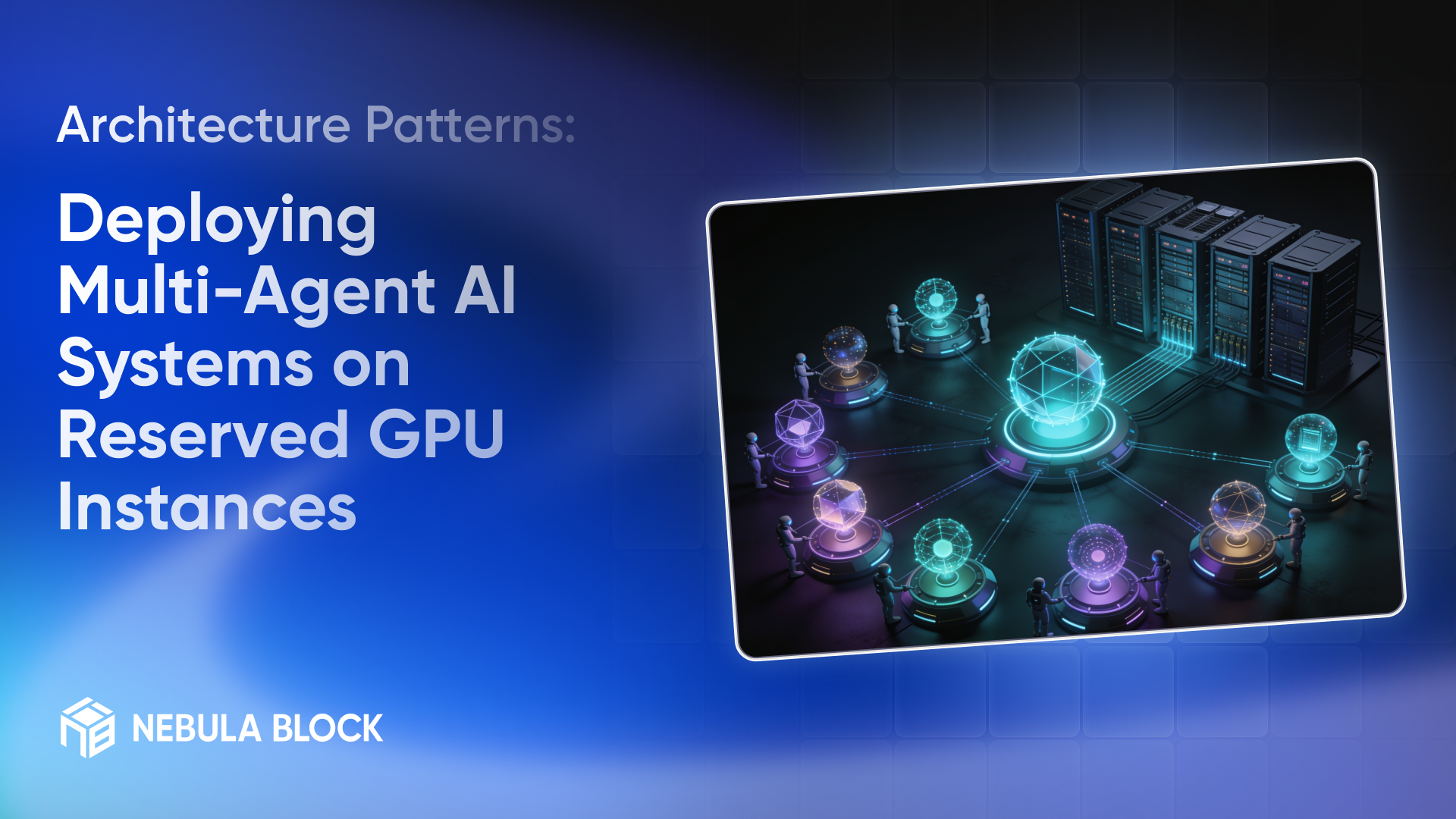
Learn how to deploy multi-agent AI systems on reserved GPU instances. This guide covers architecture design, cost optimization strategies, horizontal and vertical scaling, agent orchestration frameworks, and best practices for running reliable, production-grade multi-agent workloads without overspending on compute
The Core Problem & Solution
- The Challenge: Single-agent systems quickly hit capability ceilings. While multi-agent systems offer specialized division of labor (e.g., Researcher, Writer, Editor), they multiply GPU memory demands and inference costs by 5x to 20x.
- The Solution: Reserved GPU instances transform highly variable, spiking API and compute expenses into a predictable, flat-rate monthly cost. This shifts the unit economics, making large-scale multi-agent architectures viable at enterprise scale.
4 Core Architecture Patterns
Pattern 1: The Orchestrator-Worker Hierarchy
[ User Request ]
│
┌───────▼───────┐
│ Orchestrator │ ◄── Small, fast model (7B - 13B)
└───────┬───────┘
┌──┼──┐
▼ ▼ ▼
[ Specialized Workers ] ◄── Large models (A100)
- Concept: A central coordinator agent receives high-level tasks, decomposes them into structured subtasks, dispatches them to specialized worker agents, and synthesizes the final output.
- GPU Strategy: Maintain the Orchestrator on persistent, low-latency mid-tier GPUs (e.g., NVIDIA A10) for rapid coordination logic. Deploy heavy Workers on dedicated high-tier GPUs (e.g., A100) to handle compute-heavy inference without blocking the coordinator.
- Best For: Structured workflows with independent subtasks, such as research pipelines, document processing, and automated content generation chains.
Pattern 2: Peer-to-Peer Agent Networks
[ Agent A ] ◄────► [ Shared Message Bus ] ◄────► [ Agent B ]
▲
│
[ Agent C ]
- Concept: Decentralized architecture with no central controller. Agents communicate directly through a shared message bus (e.g., Redis, RabbitMQ), subscribing to and publishing specific message and event types.
- GPU Strategy: Strongly requires reserved instances to guarantee always-on availability and sub-second responsiveness. To mitigate idle compute costs when specific agents are inactive, deploy multiple smaller models onto a single large GPU using frameworks that support process-level time-sharing.
- Best For: Highly scalable, decoupled systems that must evolve incrementally, such as automated customer service platforms and adaptive enterprise workflow engines.
Pattern 3: Pipeline Chains with Handoffs
[ Ingestion ] ──► [ Processing ] ──► [ Analysis ] ──► [ Generation ] ──► [ Review ]
- Concept: Linear execution sequence where the output of one specialized agent serves directly as the input for the next. No coordination overhead or shared state complexity.
- GPU Strategy: Profile the pipeline to identify the specific throughput bottleneck (typically the text generation stage). Allocate higher VRAM limits to that bottleneck or batch multiple pipeline executions through it. Spot instances can be selectively used if the pipeline runs on an asynchronous, non-real-time batch schedule.
- Best For: Stable, predictable AI workflows such as ETL data enrichment, document transformation, and automated quality-scoring systems.
Pattern 4: Critic-Actor Loops
┌─────────┐
User Input ──► │ Actor │ ──► Draft Output
└────▲────┘ │
│ ┌────▼────┐
└─ Revise ──┤ Critic │
└────┬────┘
▼ (On Approval) -> Final Output
- Concept: High-stakes quality control pattern. An Actor agent generates a draft; a Critic agent evaluates the draft against structured criteria and loops feedback to the Actor for revisions until the rubric is met.
- GPU Strategy: Highly inference-intensive, scaling up compute demands by 3x to 5x per request.
- Optimization: Pair a large, high-capability model for the Actor (e.g., 70B) with a smaller, significantly faster model for the Critic (e.g., 13B) focused strictly on checking structured validation rules.
- Best For: High-stakes domains where errors are costly, such as legal document drafting, medical content generation, and automated code review.
Universal Cross-Pattern Considerations
- Isolated Memory Spaces: Never allow agents to share a process or GPU memory allocation. Enforce strict isolation where each agent is an independent process communicating exclusively via REST, gRPC, or message queues. This enables independent hot-swaps, rollbacks, and crash resilience.
- Trace Observability: Multi-agent failure modes are highly non-obvious (e.g., semantic deadlocks, loop hallucinations). Implement centralized tracing to log every single agent invocation, inter-agent payload, and precise timestamp.
- Automated Circuit Breakers: While reserved compute guarantees cost predictability, runaway agent loops can still exhaust system infrastructure. Implement a hard cap on maximum allowable iterations per request, paired with a circuit breaker to automatically halt execution paths if per-hour compute thresholds are breached.
Choosing Your Pattern
The patterns above aren't mutually exclusive. Real production systems often combine them: a Pipeline Chain feeding into an Orchestrator-Worker cluster, with a Critic-Actor loop at the quality-sensitive stages. Start with the simplest pattern that meets your requirements, instrument it thoroughly, and layer complexity only where the data shows you need it.
The reserved GPU infrastructure decision is orthogonal to the architecture pattern but it's the decision that makes serious multi-agent deployment economically practical. Variable, on-demand GPU pricing at multi-agent scale is genuinely prohibitive. Reserved compute changes the unit economics and, with them, what's worth building.
Learn more at
- Email: contact@nebulablock.com
- Website: nebulablock.com
- Docs: docs.nebulablock.com
- Book a call: nebulablock.com/contact