Why Point-Solution Vector Databases Fail the Enterprise Long-Term Scale Test
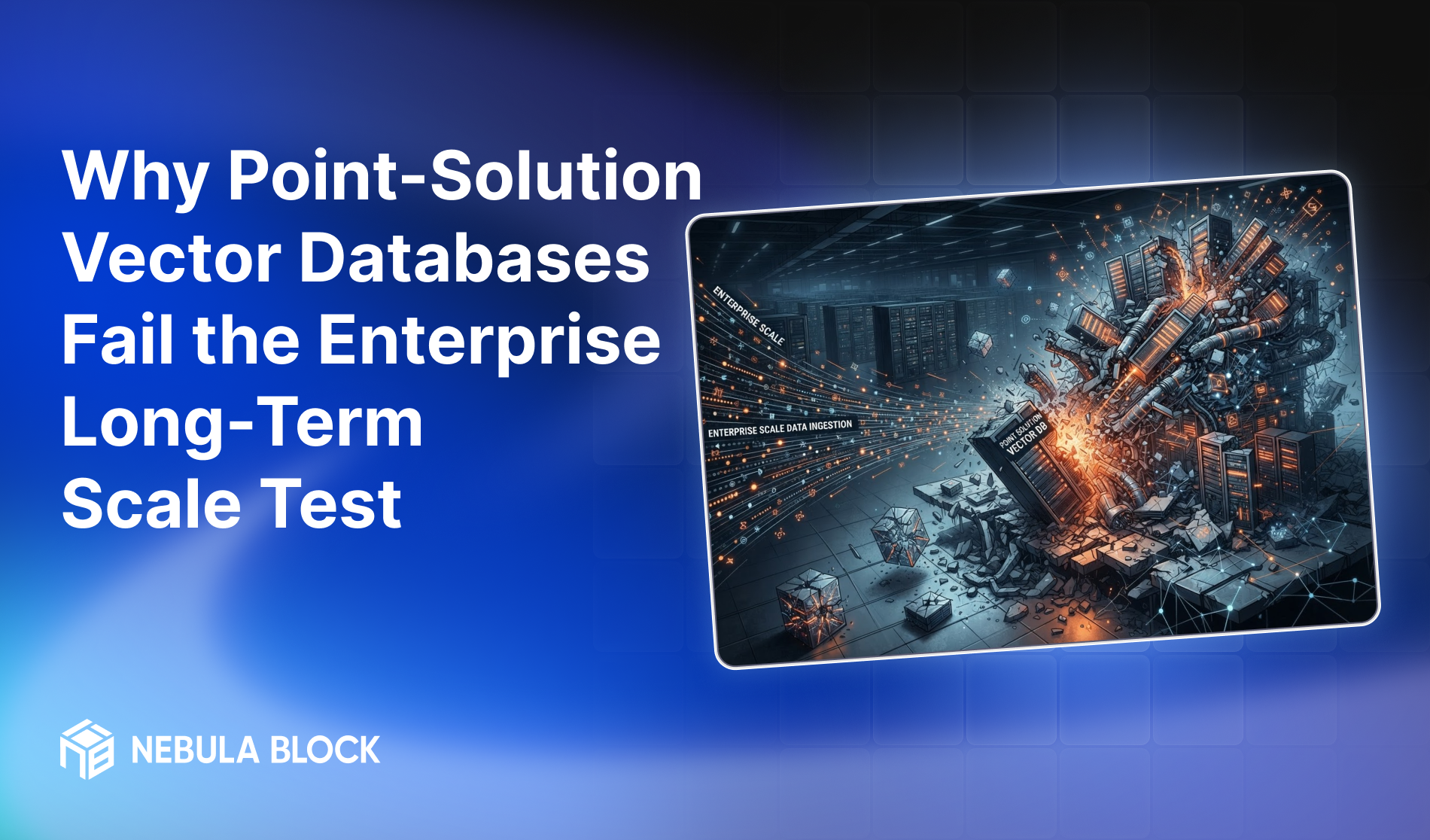
During early Proof-of-Concept (PoC) phases, engineering teams frequently rely on specialized, point-solution vector databases like Pinecone, Qdrant, or Chroma. Their value proposition at this stage is undeniable: simple APIs, fast initial integration, and rapid prototyping for AI applications like Retrieval-Augmented Generation (RAG).
However, as AI projects move from small-scale pilots to production-grade enterprise deployments, these niche, single-purpose databases often encounter severe performance bottlenecks, operational friction, and skyrocketing costs. What works smoothly for a few million vectors and a handful of users frequently collapses under real-world enterprise demands.
Here are four key technical and operational reasons why point-solution vector databases fail the long-term enterprise scale test—and what architecture should replace them.
4 Technical Bottlenecks of Point-Solution Vector Databases at Scale
1. Granular RBAC and Security Bottlenecks
Enterprise environments demand strict, dynamic Role-Based Access Control (RBAC) to ensure compliance with privacy regulations (such as GDPR, HIPAA, or SOC2). Users must only retrieve information they are explicitly authorized to view.
Point-solution vector databases usually attempt to handle authorization using metadata pre-filtering or post-filtering on vector queries:
- Pre-filtering restricts the search space before running vector nearest-neighbor algorithms, which significantly degrades graph traversal quality and ruins search recall.
- Post-filtering runs vector searches first and removes unauthorized results afterward. If a query returns top-20 results and a user lacks permissions for 18 of them, search precision collapses, causing latency spikes as the system continuously fetches replacement vectors.
When security policies, user roles, and document access control lists (ACLs) scale into the millions, maintaining consistent data security within a standalone vector DB becomes a performance and maintenance nightmare.
2. Index Degradation and High Mutation Costs
Most vector databases rely on graph-based index structures, such as Hierarchical Navigable Small World (HNSW), to achieve high-speed approximate nearest neighbor (ANN) retrieval. While HNSW offers exceptional read performance on static datasets, it is notoriously inefficient for dynamic write workloads.
In active enterprise data pipelines, data undergoes constant updates, deletes, and insertions (CRUD operations). Updating an HNSW graph requires complex node re-linking, consuming massive CPU and RAM resources. Under heavy write throughput:
- Search performance suffers during index rebuilding.
- Stale vectors remain visible during async re-indexing, leading to inaccurate AI responses.
- Garbage collection and memory compaction create unpredictably high operational latency.
3. Disjointed Hybrid Search Architecture
While vector search excels at understanding broad semantic concepts and contextual similarity, it notoriously struggles with exact matches—such as SKU numbers, error codes, specific user IDs, or exact legal terminology.
To bridge this gap, teams building on point-solution vector databases are forced to set up dual infrastructure: running a dedicated vector DB alongside a traditional keyword search engine like Elasticsearch or OpenSearch. This hybrid approach introduces serious architectural headaches:
- Data Synchronization Gaps: Keeping two separate engines synced in real time leads to eventual consistency bugs.
- Operational Overhead: Teams must maintain duplicate data pipelines, monitor twice as many systems, and write complex application-level logic to fuse and re-rank results from both engines.
4. Prohibitive Infrastructure Costs (The "RAM Wall")
To maintain millisecond-level search latencies, point-solution vector databases traditionally retain full index structures directly in high-speed RAM. This is manageable with a few gigabytes of embeddings, but it quickly hits an expensive infrastructure wall as data scales to hundreds of millions or billions of high-dimensional vectors.
Scaling RAM horizontally to accommodate index growth results in exponentially rising cloud bills. Techniques like scalar or product quantization can compress memory footprints, but often come at the expense of recall accuracy and higher CPU overhead during decompression — forcing a lose-lose choice between search quality and cloud expenditure.
The Strategic Path Forward: Integrated Enterprise Data Infrastructure
Long-term enterprise AI strategy requires moving away from isolated vector silos toward integrated, multi-modal data infrastructure. Instead of bolting on another disconnected database, enterprises should look toward holistic architectures that bring vector capabilities directly into their core data layer:
- Native database vector extensions — leveraging vector capabilities within databases enterprises already run, such as PostgreSQL with
pgvector, Databricks, or Snowflake, so vector search benefits from mature transactions, unified logging, and built-in RBAC from day one. - Enterprise context engines — adopting unified platforms like Nebula OS that bring vector indexing, relational data, graph relationships, and full-text keyword search under a single security policy and operational plane.
This isn't a problem unique to vector databases — it's the same point-solution pattern showing up across the enterprise AI stack. We've written previously about why agentic AI is replacing point solutions across the enterprise stack and the ROI of replacing five point solutions with one AI operating system; the vector database layer is simply where the pattern is currently most visible.
By consolidating vector capabilities into an integrated data platform, enterprise teams eliminate data-sync pipelines, lower infrastructure expenditure, and deliver predictable, secure AI search at scale.
If your team is hitting these limits in production, Nebula OS was built to be the integrated data layer described above — happy to walk through how it maps onto your current stack.
Learn more at
- Email: contact@nebulablock.com
- Website: nebulablock.com
- Docs: docs.nebulablock.com
- Book a call: nebulablock.com/contact