When Anonymization Fails: Synthetic Data vs. PII Masking in LLM Pipelines
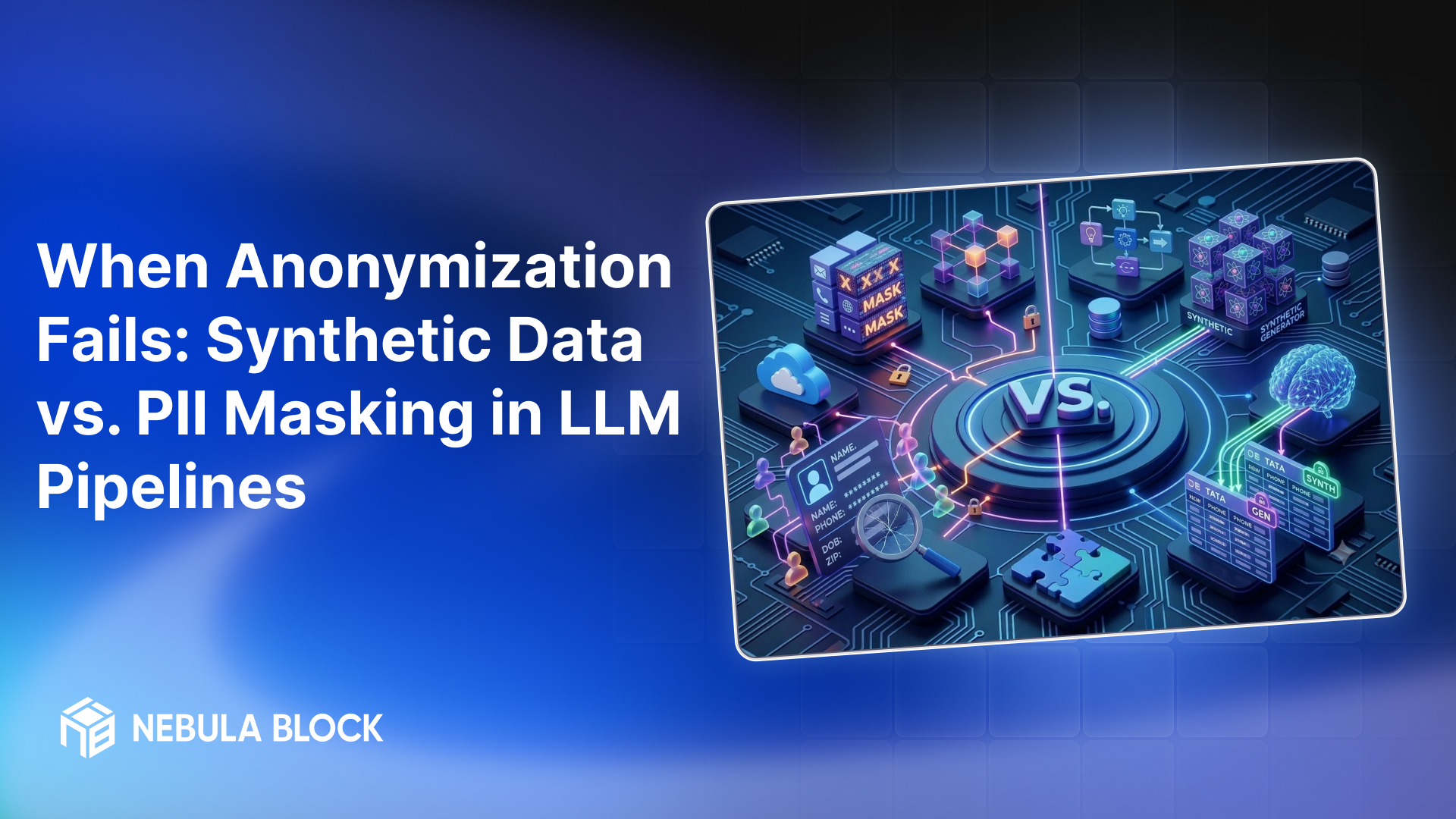
"We anonymized it" is one of the most common answers to "is this data safe to use," and one of the least reliable. Anonymization is treated as a binary — either data is anonymized or it isn't — when in practice it's a spectrum of techniques with very different guarantees, and the most commonly used one, PII masking, is also the one most likely to give teams false confidence.
For LLM pipelines specifically, where the same data may be embedded, retrieved, summarized, and reasoned over in ways that weren't anticipated when the anonymization strategy was chosen, that false confidence is a real liability.
Why PII masking feels safer than it is
PII masking works by detecting personal identifiers — names, emails, phone numbers, national ID numbers — and replacing them with placeholders or redacted tokens before the data enters a pipeline. It's fast, relatively cheap, and easy to explain to a compliance team, which is why it's the default choice in so many organizations.
It also has failure modes that don't show up until the data is actually used at scale.
Pattern-matching is incomplete by nature. Masking tools rely on recognizing known formats — a string that looks like an email, a sequence of digits that looks like a phone number. Identifiers that don't match a known pattern (a nickname, an internal employee ID, an unusual name format, a reference number specific to one business) routinely slip through undetected.
Quasi-identifiers survive masking. Removing a name doesn't anonymize a record if the remaining fields — job title, department, location, a specific date, a rare combination of attributes — are unique enough to re-identify the person anyway. This is a well-documented re-identification pattern, and masking pipelines that only target obvious identifiers leave it completely open.
LLMs can infer what was redacted. A masked document that reads "[REDACTED] joined the company in 2019 as the only VP of Engineering hired that year" hasn't actually protected the person's identity — the model, and a sufficiently motivated reader, can infer it from context. Masking removes the literal token; it doesn't remove the information.
Masking degrades utility. Aggressive masking to close the gaps above tends to strip out exactly the contextual detail that made the data useful for training or evaluation in the first place, creating a direct tension between privacy and data quality that gets resolved, more often than it should, in favor of leaving more identifying detail in.
Embeddings can retain identifying signal even after masking. When masked text is embedded for retrieval, the vector representation can still encode enough of the surrounding context to make similarity-based re-identification possible, even though the literal PII string is gone.
Where synthetic data does better — and where it doesn't
Synthetic data generation takes a different approach: instead of redacting real records, it generates new records that preserve the statistical properties of the original data without mapping to any real individual.
What it solves well. Properly generated synthetic data has no direct one-to-one correspondence to a real person, which removes the most severe re-identification risks by construction rather than by pattern-matching after the fact. It also tends to preserve statistical utility better than aggressively masked data, because there's no tension between "remove enough detail to be safe" and "keep enough detail to be useful" — the data was never tied to specific individuals to begin with.
Where it introduces new risk. Synthetic data is only as private as the process that generated it. If the generative model was trained on real, sensitive records, it can memorize and reproduce fragments of that training data in its synthetic output — a well-documented failure mode for generative models trained without privacy-preserving techniques. Synthetic data can also leak information through membership inference: a sufficiently sophisticated attacker may be able to determine whether a specific real record was part of the training set, even without recovering the record itself.
Fidelity is a genuine tradeoff, not a solved problem. Synthetic data that's too close to the real distribution risks leaking patterns from real individuals; synthetic data that's too far from the real distribution loses the utility that justified generating it in the first place. Getting this balance right requires deliberate validation, not a one-time generation step treated as finished work.
A side-by-side comparison
Neither column is "solved." Both require active validation, not a one-time implementation.
The layered approach that actually holds up
Treating either technique as a complete answer is the mistake. What tends to hold up under real scrutiny is a layered approach:
Data minimization before anything else. The safest data in a pipeline is data that was never ingested in the first place. Before choosing a privacy technique, teams should be asking whether the full dataset needs to be there at all, or whether a narrower subset would serve the same purpose.
Masking and synthetic generation as complementary, not competing, techniques. Masking obvious identifiers before synthetic generation reduces the risk of a generative model memorizing them directly; synthetic generation after masking reduces the residual re-identification risk that masking alone leaves behind.
Differential privacy techniques where the risk profile justifies the complexity. For the highest-sensitivity pipelines, formal privacy guarantees — adding calibrated noise during training or generation — provide a mathematical bound on re-identification risk that neither masking nor unconstrained synthetic generation can offer on its own.
Access controls as a backstop, not an afterthought. Privacy techniques reduce risk; they don't eliminate the value of restricting who can query a pipeline, what they can retrieve, and how much of a dataset a single query can expose at once.
Ongoing adversarial testing. Re-identification and membership inference risks change as new auxiliary data sources become available. A privacy technique validated once at launch needs periodic re-testing — including active attempts to re-identify records or extract training data — rather than a one-time sign-off treated as permanent.
The takeaway
"Anonymized" is not a fixed state; it's a claim that holds up only as well as the specific technique behind it and the ongoing effort to validate it. PII masking and synthetic data solve different parts of the privacy problem, and both fail quietly when treated as a finished task rather than a continuously managed risk.
For LLM pipelines specifically — where data gets embedded, retrieved, and reasoned over in ways that are hard to fully predict in advance — the organizations that hold up under scrutiny are the ones that stopped asking "did we anonymize this" and started asking "how would we know if we didn't."
Learn more at
- Email: contact@nebulablock.com
- Website: nebulablock.com
- Docs: docs.nebulablock.com
- Book a call: nebulablock.com/contact